


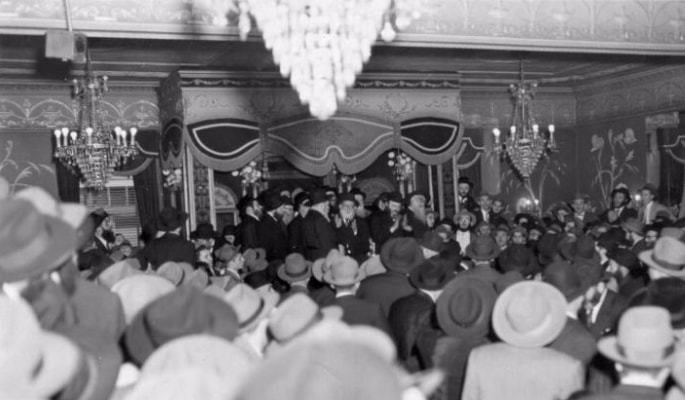
Brooklyn, NY, 1958: At 8:30 in the evening the Rebbe arrived at the Albany Manor hall. The Rebbe’s synagogue, at 770 Eastern Parkway, was too small to accommodate the crowds expected to gather for the Purim celebration. By the time he left, it was approximately 5:30 a.m, and the next day was already dawning. At one point, well after midnight, the Rebbe remarked that they had reached the status of “not knowing” so far as time was concerned, referencing the Talmudic imperative to celebrate to the point of “not knowing” the difference between Haman and Mordechai. (Megillah, 7b.)
Over the course of the nine intervening hours, the Rebbe delivered a series of inspired talks on the awesome significance of the day, and on the contemporary application of the dramatic story recorded in the Megillah. With each successive talk, the Rebbe grew more animated and more engaged, calling on his listeners to enter fully into the spirit of the holiday, and to transcend all their mundane concerns and rational anxieties. In some talks, the Rebbe grappled with profound questions on the interplay of reason, will, and moral instinct. In others, he probed the nature of Jewish identity, and the place of the Jew within the wider world. Between these talks he led the crowd in song and raised his glass time and again to wish individuals “Lchaim!”
At one point, the crowd sung a complex and contemplative melody, and the room was filled with a sense of solemn ascent and soul searching. When the melody came to its conclusion, the Rebbe admonished them for their solemnity and demanded they sing a joyous Purim song. The next song leaped with jollity, but the Rebbe was still not satisfied. As soon as the second song was finished, he began an intensely lively song of his own choosing, whooping and cheering as he led the chorus.
It was already late, and some might have thought this would be the climax. But the Rebbe was just getting started. Later in the evening he devoted several talks to the Yeshiva Tomchei Temimim, which had originally been founded by the Fifth Rebbe of Chabad in 1897, and was celebrating the 18th year since it had been re-established on American shores in the midst of the Holocaust. Here the Rebbe elaborated on several famous talks by the Fifth Rebbe, the Rebbe Rashab: To enter the Yeshiva, he explained, is to divorce oneself from the world and to commit oneself entirely to spiritual pursuits. Yet it must be understood from the very outset that this divorce is a temporary one, and that the real purpose of entering the Yeshiva is to equip oneself to engage the world and to transform the world. He also discussed the Fifth Rebbe’s bold declaration that “all the mitzvot relate directly to the essence of G‑d.”
At a later point, the Rebbe led the crowd in a heartfelt rendition of Ani Maamin: “I believe with perfect faith in the coming of Moshiach. Though he tarries, nevertheless I believe!”
In the final talk, at about 5 a.m., the Rebbe extolled the dedication and initiative displayed by Esther, emphasizing the integral role that Jewish women must continue to play in transforming the world into a home for G‑d.
For audio recordings of many of these talks and songs click here. For a Hebrew transcript click here. Below are six nuggets of insight from amongst the great wealth of teachings imparted by the Rebbe over the course of the night, freely rendered and abbreviated in English:
1. Why Is Purim a Working Holiday?
The Talmud tells us that Mordechai and Esther originally wanted Purim to be a holiday on which work is forbidden, as it is on the major Biblical festivals, but the Rabbis did not accept this. (Megillah, 5b.) The Chassidic masters explain that work does not stand in opposition to the sacred joy of Purim. On the contrary, work should itself be seen as a sacred activity. To work is to bring holiness into the mundane world, to improve the world, to transform the world into a dwelling place for G‑d. Indeed, all the categories of work forbidden on Shabbat and on Biblical holidays, are the same categories of work that were required for the construction of G‑d’s sanctuary, the Mishkan, as described in the Torah. Accordingly, the licence to work on Purim is actually a sacred imperative to transform the entire world into a sanctuary for G‑d.
2. The “One” in Every Word
There was once a Jew who was, in intellectual terms, a simpleton. It was doubtful if he even knew the meaning of all the words in the daily prayer liturgy. Yet for 40 years, he prayed intensely and at great length, and not only on the High Holidays, or on Shabbat, but each and every day: Sunday, Monday, Tuesday etc. When others asked what inspired him with such constant passion, he responded, “I’m not a knowledgeable person, but 40 years ago, I heard this teaching from the Alter Rebbe: Our sages say that in the Ten Commandments, G‑d miraculously pronounced the two words ‘remember’ and ‘guard’ [the Shabbat] in a single utterance (zachor ve’shamor b’dibbur echad). Lifted from its original context, it can be read as an imperative: “In [each] word, remember and guard the ‘One.’” This means that in every word you utter, you must preserve your consciousness of the One G‑d in whose presence you stand.” Indeed, at all times, you must “remember and guard” the One that animates every aspect of existence and of your experience. With this simple thought, you can serve G‑d for 40 years, pouring out your soul in prayer. Indeed, the Talmud tells us that it takes 40 years for a student to fully assimilate the teachings of his master.
At this point, the Rebbe began singing Darkecha Elokeinu, a song usually sung in the period leading up to the High Holidays.
3. The Work of Purim: Be Joyous!
In addition to the broad mandate of working to transform the world, which applies constantly, each day has its specific work tasks, both spiritual and physical. Our constant mission is to “serve G‑d with joy.” (Psalms, 100:2) But, for the most part, the chief mandate is to “serve G‑d,” with joy being a secondary condition of our daily work. But, when we come to the month of Adar, we are specifically called on to “increase joy,” (Taanit, 29a) and on Purim the specific work of increasing joy is brought to its ultimate climax. Indeed, the other work tasks of Purim are governed by certain limitations. The Megillah must be read, once on the eve of Purim, and once on Purim day, and no more. Charity must be given to two paupers, a gift of two foods to a friend. But the obligatory task of being joyous encompasses the entire day with complete equality.
4. The Intoxicating Triumph of Good Over Evil
The Talmud tells us “One is obligated to drink wine until one no longer knows the difference between ‘cursed is Haman’ and ‘blessed is Mordechai.’” This formulation contains an inherent paradox: The entire celebration of Purim is predicated on the distinction between good and evil, and on the miraculous triumph of blessed Mordechai over cursed Haman. Yet, we are instructed to transcend all knowledge of this distinction in order to celebrate it! The key to this paradox is that this transcendence of reason and knowledge is defined by the essential joy that is its foundation. Joy, even irrational joy, is fundamentally tethered to our essential humanity, to the divine soul, to the inner feeling of transcendent purpose and pleasure that is the unconscious core of our moral compass. On Purim we are tasked with becoming conscious of this unconscious core, intoxicating ourselves with the joyous fact that even when reason is overcome, good will yet triumph over evil.
Click here for a video class exploring this theme, and related themes, as developed in the chassidic discourse delivered by the Rebbe in 1958.
5. “The Peoples of the Land Made Themselves Jewish”
With the dramatic fall of Haman, the Megillah records, “the Jews had light and joy, and gladness and honor … and many of the peoples of the land made themselves Jewish because the fear of the Jews was upon them.” (Esther, 8:16-17.) R. Moshe Isserles, the great halachic master known as Ramo, writes that this doesn’t simply mean that “the peoples of the land” were afraid of the Jews, but rather that they acquired the Jewish quality of having “fear of G‑d.” How were the other peoples inspired with fear of G‑d? They were not impressed by the Jews’ prayer and Torah study alone, but by the fact that even in the secular realm, in the activities that the Jews shared with “the peoples of the land,” it was evident that they felt themselves to be standing in the presence of G‑d. This inspired “the peoples of the land” to likewise imbue all their activities with a “Jewish” sense of sacred duty, with fear of G‑d. As the Talmud says, “anyone who denies idolatry is called a Jew.” (Megillah, 13a.)
6. Esther: A Woman of Valor, Understanding and Initiative
“The Jews had light and joy…” and the Talmud comments “light refers to Torah” (Megillah, 16b), for the Jewish people now embraced Torah of their own initiative, dedicating themselves to G‑d more deeply than they did at Mt. Sinai (Shabbat, 88a). The Alter Rebbe points out that the word used in this verse for “light” is the feminine form, orah, rather than the masculine or. (Mamarei Adhaz 5564, 62.) He connects this to the Talmudic adage, “greater understanding is given to women than to men.” (Nidah, 45b.) This indicates that for Torah to be fully internalized—for it to overcome all opposition and transform the world intellectually, culturally, and actually—it is integral that Jewish women emulate Esther, who risked her life for her people. As the Alter Rebbe explains elsewhere, she even acted of her own initiative: Without consulting Mordechai, she invited Haman to feast with her twice, understanding that he could not come so close to holiness and survive. (Torah Or, 93d.)
After the last talk the Rebbe instructed that the Shalosh Tenu’ot melody—attributed to the Baal Shem Tov, the Maggid of Mezritch, and the Alter Rebbe—be sung. At its conclusion he began singing the melody of the fourth Chabad Rebbe, the Rebbe Maharash, known as Le’chatchilah Ariber. After that the Alter Rebbe’s melody, Daled Bavot, was sung, followed by Nye Zhuritze Chloptzi.



Beautiful!
Thank you
Fan from Pittsburgh