


After what is believed to have been the largest rally ever in France after terror attacks rocked the city of Paris for a week—including the participation of more than 1.5 million people, and 40 presidents and prime ministers from around the world—French citizens have returned to work and school with a question that looms over daily life: What next?
For Chabad-Lubavitch leaders, the answer is clear: Jews cannot be afraid or concerned about being there, and should proudly exhibit their Jewish identity and increase in the performance of mitzvahs.
“You cannot put your head down; you have to keep going and keep up hope,” says Rabbi Mendel Azimov, co-president of Chabad-Lubavitch in Paris. “As a Chabad rabbi, you know that people are looking up to you. Someone asked me, ‘Why don’t you close for Shabbat’? But closing a shul is not just a matter of opening and closing for two hours.”
Rather, “it is a symbol of Jewish life.”
As the hostage crisis unfolded on Friday afternoon, some law-enforcement officials urged shuls to close on Shabbat—which would have been the first time they would be closed since World War II—yet Chabad shuls remained open and used the opportunity to increase their prayers.
“We didn’t want to close because we didn’t want to give another victory to our enemies,” states Rabbi Chaim Shneur Nisenbaum of the school Complexe Scolaire Beth Haya Moushka in Paris, which houses a popular local synagogue.
“We said extra prayers and recited Tehillim (Psalms),” adds Azimov. “And there were more Jews that came on Shabbat day than usual because they wanted to pray and to do something in honor of the situation.”
1 Million Mitzvah Campaign
Taking their cue from the Lubavitcher Rebbe, Rabbi Menachem M. Schneerson, of blessed memory—who taught to focus on increasing in goodness—French Jewry is also spearheading a campaign to garner mitzvahs in honor of the victims.
“The goal is to have 1 million people accept an additional mitzvah or good deed,” explains Chabad Rabbi Chmouel Lubecki, co-director of Beth Loubavitch in Rouen in northern France. “The idea is spreading through social media such as Facebook and WhatsApp, and we see tremendous traction, as people seek to channel their grief into concrete positive action.”
There is also a drive in the Jewish community in France to raise money for the families of the four victims of the attack on the Hyper Cacher grocery store.
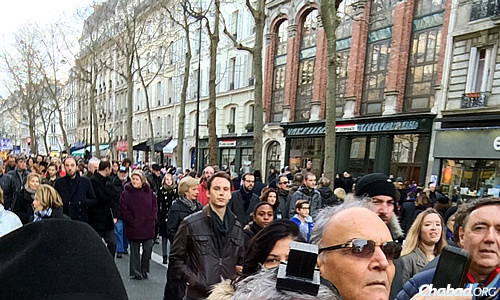
At the massive rally on Sunday, many Jewish men and boys embraced the opportunity to don tefillin, as a group of Chabad rabbis, students and volunteers ambled through the crowd offering help to those who wished to partake in the mitzvah, demonstrating their proud, public identification as Jews.
Those who wrap tefillin during such times, says Azimov, “feel it’s a way they can participate and show their Jewish identity.”
On a Facebook posting on Monday morning, Rabbi Yosef Yitzchok Amar of Beth Chabad Seine et Marne in France called for a million Jews to wear their kipahs visibly.
“It is prohibited to bow before terror,” the rabbi wrote, adding that “the freedom to worship is an important value in France. If they want to kill us … we will respond and react as Jews by adding in the practice of mitzvot. …”
“People must keep their pride of being Jews,” stresses Nisenbaum. “If we are afraid, then we are giving a victory to our enemies, and this is impossible. We have to be better Jews, stronger Jews and more confident Jews than ever.”

Security Concerns Remain on Minds
The national soul-searching in France focuses on what can be done to stop terrorism and anti-Semitism, which has been plaguing the country for some time now. Though it was vividly highlighted this past week, the problems have been ongoing, and have included vandalism and attacks on synagogues, and more.
In just the first half of 2014, more than 500 attacks against Jews were reported in France. The situation heightened in intensity this summer during Israel’s war with Hamas in Gaza. An estimated 500,000 Jews live in France, many of them in the Paris metropolitan area, and smaller cities such as Marseille, Strasbourg, Lyon and Toulouse.
But the recent turn of events made international headlines everywhere: First on Wednesday, with terrorists murdering 12 people at the offices of the satirical magazine Charlie Hebdo; followed on Thursday by the killing of a female police officer; and ending the work week on Friday with an armed gunman holding Shabbat shoppers hostage in a grocery store, resulting in the deaths of four Jewish men—and his own.

Jewish community leaders met Sunday morning with French President François Hollande, who promised to increase security around Jewish synagogues, schools and sites, while members of the Jewish community vowed to stand strong and proud.
“Everybody is asking for more security,” says Rabbi Chaim Shneur Nisenbaum of the school Complexe Scolaire Beth Haya Moushka in Paris. “In all the Jewish schools now, the parents are asking for more security because there is a risk. People won’t continue to send their children to the Jewish schools because they are afraid, so we have to give them assurances that everything will be all right—and we are doing that.”
On Monday, France dispatched more than 10,000 additional police and security personnel to Jewish school and other sensitive sites.
The meeting between communal leaders and the French president took place hours before the massive unity rally that saw more than 1.5 million people take to the streets of Paris, along with the leaders of some 40 other countries, including Israeli Prime Minister Benjamin Netanyahu, German Chancellor Angela Merkel and British Prime Minister David Cameron.
Similar rallies were held in other cities; estimates suggest that some 4 million people participated in such demonstrations across the country.
Nisenbaum notes that he and others attended the mass rally—believed to be the biggest such public display in France since World War II—to show that the terrorists weren’t just out to destroy the French ideal of “liberté, egalité, fraternité [liberty, equality, fraternity],” but also to destroy Jews and Jewish life itself.

A Show of Solidarity
For many Jews, even those who weren’t directly affected by the week’s events, this past Shabbat came with unique challenges.
On Saturday night, Rabbi Mendy Mergui of Chabad of Maisons Alfort in Creteil, France, hosted two survivors of the harrowing siege for a special Chassidic gathering, during which words of inspiration were interspersed with stirring Chassidic melodies. Most appropriately, the assembled sang the Chabad melody, “Padah Beshalom,” a song of thanksgiving sung to commemorate miraculous delivery from harm.
“This Shabbat was a very painful one,” recounts one woman associated with the Jewish school system in Paris. “At first, we heard the happy news that the terrorists,” including the two brothers who on Wednesday killed 12 people at the offices of Charlie Hebdo magazine, “were shot. Shortly after that, we heard that a few of our brothers were taken as well. We are all bleeding for the families of the lives that were lost.”
“It is our family,” the woman went on to say. “We are all one family.”
And it is a family that, in some fashion, at least temporarily, appears to be gaining supporters.
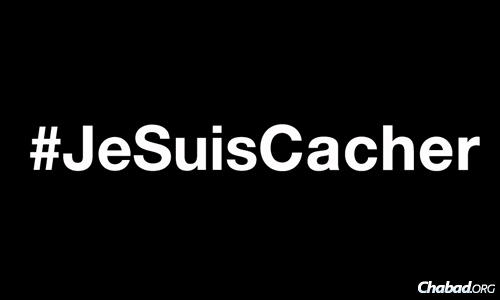
Across the city and on social media, French citizens held banners and sent messages that read “Je Suis Juif” (“I Am Jewish”) and “Je Suis Cacher” (“I Am Kosher”). The wording echoes a similar campaign undertaken on Thursday after the slaughter of 12 people at the offices of Charlie Hebdo when people began posting messages that said “Je Suis Charlie” (“I Am Charlie”).
But will such solidarity last?
“We’ll have to see in the future how people think [about anti-Semitism],” sums up Nisenbaum. “The whole of Europe has a problem with such things, and they don’t know how to look at it …
“We have to tell them that these people are fighting against the values of the free world. They don’t want liberty or democracy, and they don’t like any differences. They want only what they want.”




To move is to run away.