

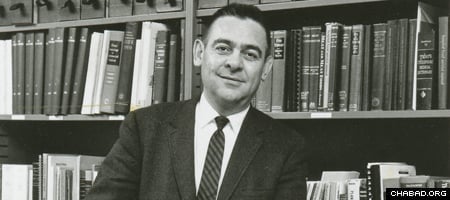
Professor Velvl Greene, former chair of epidemiology and public health at Ben-Gurion University, professor emeritus there, and director of its Lord Jakobovits Center for Jewish Medical Ethics, passed away at the age of 83. A pioneer in the field of hygiene and the development of sanitary standards used in hospitals, he maintained at the height of his career a scientific and religious dialogue with the Rebbe, Rabbi Menachem M. Schneerson, of righteous memory. He became a highly regarded lecturer on Torah and its compatibility with science, and also contributed to NASA’s search for extraterrestrial life.
Born in Winnipeg, Manitoba, in 1928, Greene was raised in a secular, but strongly Zionist, home. His love of the Holy Land led him to study agriculture at the University of Manitoba, a decision he explained in interviews as rooted in an intention to “go to Israel to work the land.”
He later served in the Canadian army, and pursued a doctorate in food science at the University of Minnesota.

In Minnesota, he met his wife Gail, and the couple remained in Minneapolis until 1956, when events surrounding the civil rights movement led him to take a teaching position at the Southwestern Louisiana Institute in Lafayette. One of many professors to arrive throughout the South after academics resigned their positions in protest of a U.S. Supreme Court decision banning segregation, Greene taught bacteriology while in Lafayette.
When a staphylococcus outbreak struck the southern United States, Greene was called upon to assist the authorities in how to curtail the epidemic.
“Staph infections were almost a thing of the past,” recalled Greene. “After the development of penicillin, most infections could be wiped out with an injection. But then, the bacteria began to be resistant to penicillin. Infectious diseases of all kinds were taking a toll; babies [and] surgical patients were dying.”
Greene pushed for the readoption of classic hygienic practices, a view regarded as groundbreaking at the time. He published a paper on his findings, and returned north to follow the epidemic, joining the University of Minnesota to continue his work.
“I wasn’t a physician, but they asked for help,” he said, “so I advocated a return to the old protocols of Semmelweis and Nightingale: Wash your hands, wear gowns, [and] isolate patients.”
After the epidemics subsided, Greene created the first university course in environmental microbiology. It attracted the attention of NASA officials, who were concerned about the possibility of spacecraft becoming contaminated by extraterrestrial microbes and infecting populations on earth. In 1960 he joined the agency’s Planetary Quarantine Division, where from a lab in Minneapolis he contributed to NASA’s search for life on Mars.
Over a career spanning decades, Greene contributed to the fields of environmental sanitation, surgical sterility and asepsis, disinfection, and hospital-acquired infections. He published more than 90 scientific papers and monographs, and lectured at universities, hospitals, government agencies and healthcare corporations all over the world.
But he also earned a reputation as a popular professor, with more than 30,000 students completing his courses in personal and community health, and tens of thousands more tuning into his early morning show on public television. In 1983 he won a Bush Foundation fellowship, and the Council for International Exchange of Scholars appointed him as a Senior Fulbright Lecturer.
Three years later, he moved to Israel, where he held faculty positions until two years ago, when he resigned to further lecture and work on his autobiography.
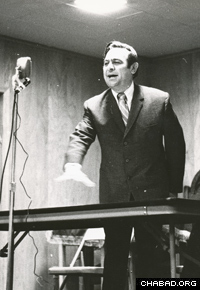
Prayer in the Afternoon
Greene liked to say that he was raised, and later built his life as, the “characteristic paradox of the modern secular Jew: interested in Jewish things but basically ignorant; active in Jewish circles but limited in choice; committed to community, family, profession and the Jewish people, but quite unaware of the foundation that informs this commitment.”
He identified the early 1960s as the time when he realized there was more to life than just being famous. He made an appearance on a North Dakota talk show, where the host quizzed Greene on issues he knew nothing about. That didn’t stop the professor from answering as if he was knowledgeable about the subjects.
“I found myself talking about juvenile delinquency and farm subsidies,” he recalled. “I didn’t know a thing about either one of them. But I had no problem giving lengthy answers to the questions.”
Watching himself on television later that night was “the first and last time [he’d] been really humbled.”
“It made me look buffoonish,” he said. “I resolved to live a more spiritual existence.”
That opportunity came knocking in the person of Rabbi Moshe Feller, regional director of Chabad-Lubavitch activities in Minnesota. Greene described his first meeting with the young, newly married rabbi as “a comedy,” but Feller, who at the time just wanted to meet one of Minneapolis’s most famous scientists and ask him to support his new center’s activities, was impressed by the professor’s Jewish sensibilities.
“He always used his Jewish name, Velvl,” Feller commented late Monday as he journeyed to Israel for Greene’s funeral. “I felt immediately that he took pride in his being Jewish.”
But Greene originally didn’t even want to meet the rabbi, and only after some prodding granted Feller 10 minutes.
“What did a black hat and beard have to do with me? I was a space scientist,” he once told an interviewer.
In the middle of their conversation, according to a 1972 account in Time magazine, Feller “suddenly looked out the window at the setting sun. [He] realized that it was time for prayer, and, asking Greene’s pardon, abruptly stopped the conversation. He turned to the window to pray.”
“I had never seen this before in my life,” Greene recalled. “Here he came into my office, wasted my time and stood there embarrassing me.
“I didn’t know what he was doing or why,” he continued. “I didn’t know Jews prayed outside a synagogue. I didn’t know they prayed in the afternoon. I didn’t know they prayed on weekdays. And I didn’t know how anyone could pray without someone announcing the page!”
After finishing his prayer, Feller apologized, telling him that “if [he] hadn’t prayed then and there, the opportunity would have been lost forever.”
Greene told the rabbi that he was a Jewish agnostic, but Feller the rabbi told him that he was just ignorant in Jewish teachings, “just as I am ignorant in microbiology.”
At the end of the meeting, Greene was “impressed by his sincerity and intrigued by his dedication.”
He later recalled that the exchange was “the first time [he] heard a rabbi mention the word ‘G‑d’ seriously.”
Greene and his wife invited Feller to speak at their Jewish book club, and were similarly affected by the rabbi’s authenticity and wholeheartedness. Greene and Feller began studying together, and over the years, the Greenes became more religiously observant.
“We became family,” said Feller.
As Time summed it up, Greene “gradually became a fully observant Lubavitcher.”
Greene, however, had a different take.
“When people ask me how I became an observant Jew, I tell them that I’ll drop them a line when I become one,” he remarked. “I’m still a work in progress.”

Science and Torah
But while Greene grew in his Jewish knowledge and observance, he had serious questions about reconciling Jewish teachings and science.
“You people are still stuck in the Dark Ages,” he once told Feller. “It amazes me that you still take the story of a six-day creation literally. The theory of evolution is accepted by virtually every serious scientist alive.”
Feller told him that he wasn’t well versed on the subject, and suggested taking the matter up with the Rebbe. After reading a widely published 1962 letter the Rebbe wrote on evolution, he did.
Greene did not mince words, and bluntly told the Rebbe what he thought about what he and other scientists believed was the correct theory.
In his reply, the Rebbe stated that his position came not from his belief, but rather from a foundation in science.
“My said letter does not appeal to ‘belief’; its premises are scientific based on my years of scientific study, first at the University of Berlin, and later at Paris,” the Rebbe wrote. “I upheld the permissibility of the Creation account in [the Book of Genesis] on scientific grounds.”
The Rebbe responded to each of the comments made by Greene, stressing that “from the viewpoint of modern science, [his own view] could be as valid as the opposite theory.”
On the contrary, the Rebbe continued, evolution could be relegated to the realm of belief. He offered up the example of one scientist with whom he spoke, who subscribed to a particular scientific theory because if he didn’t, “he would lose his standing in the academic world, since he would be at variance with the prevalent legacy from the 19th century.”
Greene would later write about such “blind acceptance,” as he called it, of scientific conjecture: To many Jews, “science and technology were not mortal enemies of Torah Judaism; they were its natural successors. In their eyes, science and technology represented progress, promise and the New World . . . The generation opted for culture and freedom [replacing] the old world.”
Greene finally came to the realization that “the mistakes in science (or the misunderstandings of Torah) are the stumbling blocks in [the Torah and Science] dialogue. The self-serving hypotheses that masqueraded as science and the ‘scientific’ dogma that have been generated over the last century cloud an honest examination of the issues.”
Greene would explain that science is limited to what can be verified. With hypotheses, you can never prove that something is the case; you can only prove that something is not the case.
“Everything else is extrapolation,” he explained. “The perceived incompatibility between science and religion springs from the mistake of having too much confidence in science’s extrapolations. We seem to have a lot of trouble admitting that we don’t really know.”
He once told a reporter: “Listen, I’ve got nothing against dinosaurs, y’know, but fossilized bones don’t have any flesh, emotions or internal organs. Many of the bones are actually missing. And yet somehow, museums see fit to build whole skeletons and add musculature. That’s serious interpolation.”
In one article, he noted that science could even make a person religious: “If we knew what goes on in our very own lives, if we knew what goes on in the birth of a baby, we would get on our knees and thank G‑d forever.
“All of the vast scientific studies that have been made over the past hundred years keep pointing to the concept of order and sequence, and therefore, in my opinion, a creator.”

On Behalf of Judaism
By the time Greene met with the Rebbe in 1963, he had grown very close to Chabad-Lubavitch in his city. The two had also already corresponded with each other.
“The Rebbe was so warm and welcoming,” he recalled of that first meeting. “He seemed more like a loving uncle than the spiritual leader of the Jewish world [that he was].”
They discussed the concept of Divine Providence, that “everything that a person sees or hears is designed by G‑d to bring us closer to Him.” The Rebbe told Greene that as a professor in a medical school and as a frequent traveller, he probably saw and heard things most people don’t experience.
“Why don’t you keep a journal, just a few notes at the end of the day, and see if you can find the divine message?” the Rebbe suggested. If he needed help finding the meaning, they could discuss it together.
Greene was amazed at the conversation.
“There was the Rebbe,” he said, “educated in math and science himself, who spoke of the soul as something real, not just an idea.”
At one point, Greene brought up NASA’s search for life on Mars.
“Is this right?” he asked. “Can I really do this? Other religions say you shouldn’t search. And the Torah doesn’t say there’s life on Mars.”
“Professor Greene,” the Rebbe replied, “you should look for life on Mars. And if you don’t find it there, you should look elsewhere. And if you don’t find it there, you should look elsewhere. Because for you to sit here and say that G‑d didn’t create life elsewhere is to put limits on G‑d, and no one can do that.”
In time, with the Rebbe’s encouragement, Greene began to lecture on Judaism and science in many Jewish communities in the United States.
“When a Jewish audience can be gathered together,” the Rebbe advised, “the opportunity should not be wasted on empty platitudes, but should be made use of to the utmost to provide them with a lasting inspiration which should be expressed in daily life.”
Once when Greene wasn’t feeling well, the Rebbe wrote a letter to uplift his spirits, offering a blessing that he “should be able to continue [his] good work for a better and happier environment, in good health and with joy and gladness of heart.”
At another time, the Rebbe requested that Greene forward him all of his scientific papers. The Rebbe would comment on them, at times pointing out contradictions between several papers.
And while Greene had wanted to move to Israel for many years prior to finally leaving the United States in 1986, the Rebbe originally advised him to stay.
“It is surely unnecessary to emphasize to you again that the only reason for my opinion that you ought to continue in the U.S.A. is that American Jewry, and especially the younger generation, have a priority claim on your services to help permeate them with [Judaism], especially after you have had such considerable [success] in this area,” the Rebbe wrote in 1978.
Greene recounted that the Rebbe told him in his first meeting: “Remember, whatever you do, you must always do more next time. If you give charity, give more the next time. If you study 10 pages of Talmud, then next time, set the goal at 100. That’s a principle of Chabad: You must always move upward.”
Greene treasured all of the letters he received from the Rebbe, and prior to his passing, started lecturing on their content to audiences in Israel.

Rich Heritage
To Greene, the realm of science informed and invigorated his commitment to Judaism.
“At my age, when I look at my grandchildren, I think, ‘Look at the miracles.’ This is what science does for you,” he said recently. “Whenever I have a problem with the learning of the Talmud, I call my grandchildren for help. It’s quite ironic: me, an academic trained in critical analysis, seeking help from my grandchildren! But they were born into the rich heritage that I had to find on my own after years of searching.”
According to Feller, when Greene heard the Rebbe talk about how the biblical Joseph stood proud and strong even as he was imprisoned among lowlifes, he “decided the Rebbe was talking to him, and took upon himself to openly wear a yarmulke.”
Greene “was serious about what he did, and once he felt it was right, he was passionate about it,” Feller surmised. “He was staunch in his Judaism.”
He was also steadfastly committed to the Rebbe’s charge to inspire those with whom he came in contact.
“He always prepared notes before he spoke,” recalled Feller. “It did not make a difference if it was to a small crowd or a large crowd. He did this because he felt that whoever he was going to speak to, those people were important. There was no person whom he felt was below his dignity. He was never condescending, even though he was a famous scientist and professor.”
“Today we’ll bless G‑d for giving us 83 years with Velvl,” Yocheved Miriam Russo, who was working with Greene on his autobiography, said just before the funeral. “And then we’ll bless Him again, for also having given us Velvl’s unique legacy, his ability to inspire, to encourage, to bring everyone who knew him, or heard him speak, closer to the True Judge.”
Some of Greene’s greatest pride was reserved for the work of his son, Rabbi Dovid Greene, director of Chabad-Lubavitch of Rochester, Minn.
“My son the shliach,” Greene would say to Feller, beaming with more pride than someone else commenting on a child who’s a doctor.
Greene once summed up his outlook with a simple observation: “Science teaches you how the heavens move. The Torah teaches you how to move the heavens.”






I just tried to send an email to Velvl and found that his email address was no longer valid. I did a Google search and found that he died almost 3 years ago. I was sorry to learn that.
I knew Velvl when he was the leader of a small Jewish youth group that I was in at the Mikro Kodesh synagogue in Minneapolis MN. Always a nice smile and something nice to say. I heard him speak twice when I lived in California ( early 2000's) on a couple of his Lubavich speaking tours. We talked for a while. He was warm and gracious.
I remember the twinkle in his eyes as he spoke, and his warm smile. We exchanged a few emails in recent years.
I knew that Velvl was an accomplished scientist, but until reading this obituary, I didn't realize how accomplished.
A really nice guy.
I also know Rabbi Moishe Feller. We grew up together. Another very nice person.
Both men were blessed with sharp wits and good senses of humor, and well grounded in reality
08-18-2014