

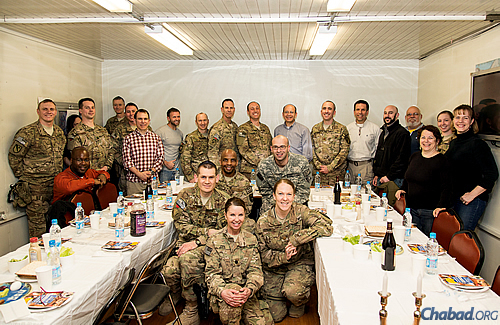
Long before most people are even thinking about doing their Passover preparations, the staff at the Aleph Institute in Surfside, Fla., is busy organizing, packing and shipping boxes of Passover products to Jewish servicemen and women in the U.S. Armed Forces.
“We send out to about 1,000 members total,” says the Aleph Institute’s Rabbi Menachem Katz, director of outreach programs for the Chabad-Lubavitch organization that provides for the spiritual and physical needs of Jewish soldiers and prisoners—and their families. “Many of them are overseas. We’ve sent packages to Afghanistan, Kuwait, Iraq, Qatar, Germany, Honduras, Korea and Japan.
“And, sometimes,” he continues, “we don’t know where they are going because we are sending them to a U.S. Naval ship. A lot of it gets shipped at least a month before Passover because some of the packages go onto ships that only get deliveries once a month or every few weeks.”
Surprisingly, while there is plenty of food to prepare and ship for Passover, the number of servicemen and women receiving holiday packages is actually smaller than it is for other holidays like Purim or Chanukah. According to Katz, “the military is more on top of Passover than other [Jewish] holidays.”
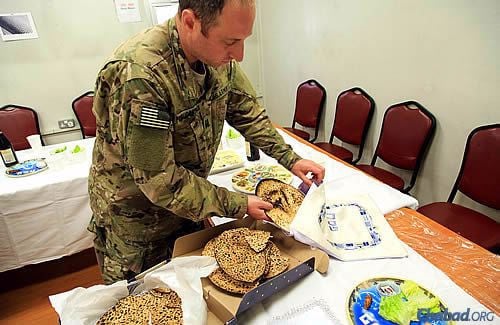
Still, Aleph makes it a priority to send boxes full of shmurah matzah, grape juice, Haggadahs and all the items found on a seder plate, including “shelf-stable, hard-boiled eggs that we manufacture special,” a zeroah (chicken neck), horseradish for maror (bitter herbs) and charoset (symbolic of the mortar and brick used by Israelite slaves in Egypt).
Some also receive soup cubes, macaroons and other kosher-for-Passover fare.

The only thing the Aleph Institute doesn’t provide is lettuce “because that would arrive flat,” says Katz.
For the chaplains and Jewish military lay leaders who receive the Passover packages, the contents truly make a difference.
As Navy reservist Mark Blumstein wrote in a letter to Katz: “I am ... in receipt of all the Passover supplies sent to me by Aleph for which I am most grateful. I am identifying Jewish soldiers and planning a base-wide seder; none of which would be possible without your package.”
In a direct response, he also noted that “it is very important to receive these products, given the remoteness of the camp that we are deployed to in East Africa. As a result, service members will be able to properly celebrate Pesach in a country devoid of such supplies.”
Blumstein adds that without such provisions, “Jewish service members are left to their own devices to find supplies necessary to celebrate Jewish holidays in an expeditionary environment. It makes me feel secure to know that organizations like Aleph exist to support the religious needs of Jews around the world in service of their country.”

‘Everything They Need’
The Florida-based organization began offering Passover kits on a small scale back in 1995 and began major distribution after the Sept. 11 terror attacks in 2001. In doing so, states Katz, they were simply following in the footsteps of the Lubavitcher Rebbe—Rabbi Menachem M. Schneerson, of righteous memory.
“I know firsthand from individual chaplains in the military and the Lubavitchers involved that the Rebbe made it his business to make sure that chaplains had shmurah matzah for Pesach,” he says.
Because of the enormity of the undertaking—some 3,000 pounds of matzah and 2,800 bottles of grape juice are shipped before Passover—Aleph actually does all the packing and shipping from a warehouse in New Jersey. The location not only gives them ample space to keep their operation moving smoothly, it also provides easy access to the plethora of kosher foodstuffs available in the New York markets.
But it isn’t just military personnel and their families who benefit from Aleph’s offerings.
Between 3,000 and 4,000 Jewish inmates across the country will receive everything they need for Passover from the Aleph Institute as well.
“We provide not only shmurah matzah, but a lot more than we even provide for the military,” responds Katz. “Macaroons, gefilte fish, soup and nuts; they wouldn’t get it without us. Some wouldn’t have a seder without us.”







Memories of East Africa on Pesach I lived in East Africa for 3 years as a Peace Corps volunteer. Pesach was a lonely and isolating time for me as I struggled with being the only observant Jew for thousands of miles and longing to observe Pesach with a community. This article brought tears to my eyes. I wish these soldiers a Kiswahili greeting of "Habari yako" and "Chag kasher v' same'ach.