


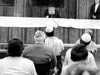
Representatives of the Ruderman Chabad Inclusion Initiative (RCII) were among guests at the White House on Thursday morning for a briefing and discussion on the accessibility for and inclusion of people with disabilities in the Jewish community.
“It was beautiful to see Jews of all walks of life coming together at the White House to open this conversation. We are grateful to the White House for initiating it,” said RCII program director Dr. Sarah Kranz-Ciment, PT, DPT. “It was great to see people asking how we can do better.”
Joining Kranz-Ciment at the event was fellow RCII team member Shelly Christensen, along with Nechama Shemtov, director of education and women’s issues at American Friends of Lubavitch (Chabad) in Washington, D.C. Christensen was among the founders of Jewish Disability Awareness Month, now known as Jewish Disability Awareness and Inclusion Month, which is held annually in February.
Opening the White House program, Judith Heumann, social advisor for International Disability Rights for the U.S. Department of State, welcomed those present and reiterated the need for inclusion in its best practice as a civil right.
Work to Be Done
Matt Nosanchuk, White House associate director of public engagement serving as the liaison to the American Jewish community, said it is “consistently clear” that the Jewish community recognizes that there needs to be space for everyone who wants to be involved. Following his remarks, speakers discussed current concerns and barriers to greater inclusion for the disabled in Jewish communal life.
Kranz-Ciment stated that the goal of the Ruderman Chabad Inclusive Initiative is to help Chabad Houses worldwide become more open to individuals with disabilities. Yet even she was surprised by how much remains to be done.
“Chabad by nature is inclusive, but our communities don’t always know it. We need to implement even more practical changes, like having Braille on our signs and having our flyers say, ‘Contact us if you need accommodations or a sign-language interpreter,’ ” she said. “If someone can’t come into our shuls, our schools, our Shabbat table, we don’t just lose that one person—which is a catastrophe—we lose their families, their friends.”
The Lubavitcher Rebbe—Rabbi Menachem M. Schneerson, of righteous memory—“taught us to welcome every Jew, but we could do it on an even better level if we had the training,” Kranz-Ciment said, adding that providing such guidance is at the heart of the Ruderman Chabad Inclusive Initiative.




This is so important for those of us with disabilities. Try conversion its not easy. We all only have the here and now. I have visual issues, struggling again. Disabilities are medical issues, its not just disability.
I would love to see an understanding that I can't do meetings on my own in the dark evenings. Study has to approached differently. The easier solution is to give up, but that's not the answer.
I feel so frustrated by having to explain why I can't do something.