

Yossi Madvig comes from a military family. His father served in the U.S. Navy during the Vietnam War. One grandfather also served in the Navy during World War II. Another grandfather worked as a machinist during World War II in a Honeywell plant in Minneapolis that made items for military use.
While joining “wasn’t necessarily expected of me,” says the 37-year-old, who grew up in a suburb of Los Angeles, “it was something I thought about as an ‘in-the-family’ type of thing,” he tells Chabad.org.
With that in mind, Madvig started reading about military chaplaincy as a college student at University of California, San Diego.
As Madvig moved into adulthood and “became more involved in Yiddishkeit,” eventually enrolling in a rabbinical seminary before becoming a Chabad-Lubavitch rabbi and emissary, he continued to think about working as a chaplain. But he had concerns about both the length of his beard and time away from his family. (Facial hair had until recently been prohibited in the U.S. military.)
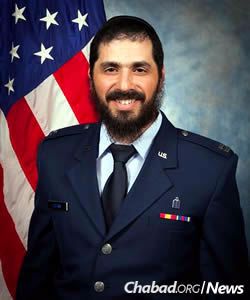
Then he heard about Chabad Rabbi Elie Estrin, who had become a chaplain in the U.S. Air Force.
“I said, ‘How did you do it? The beard?’ ” recalls Madvig, who with his wife, Chana, co-directs Chabad of Oswego, N.Y. He learned about the possibility of serving as a chaplain in the U.S. Army Reserve, and that the Department of Defense had recently eased its rules on beards and other displays of religious belief.
Rabbi Menachem Katz, director of outreach programs at the Aleph Institute—a Florida-based, Chabad-affiliated organization that provides social services and Jewish resources to military personnel and their families—noted that the Aleph Institute worked diligently on this issue and had been eagerly awaiting the rule change.
Other Chabad rabbis who currently serve as chaplains in the U.S. military include Rabbi Mendy Stern and Rabbi Levy Pekar. Katz says a few more Chabad rabbis are about to join or are considering joining.
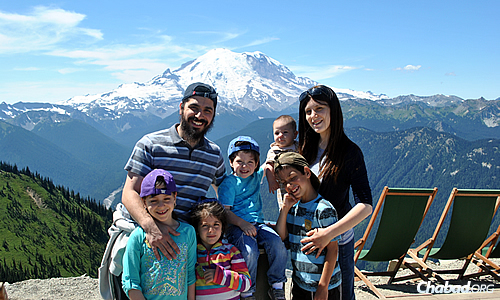
With that, Madvig started to look more seriously into the program. On May 14, the father of seven joined the U.S. Army as a chaplain.
‘A Cool Thing’
“I’m a patriotic type person, so being in the military and helping out the troops in the way that I can, Jewishly, sounded right up my alley,” says Madvig. He hopes to serve his country in a manner similar to that of his family members (who were all enlisted, rather than in the reserve), but from a different place: the rabbinate.
“Helping soldiers is a cool thing; it’s a little like being a campus rabbi,” he says, noting that in addition to the Oswego Jewish community, he and his wife serve students at SUNY Oswego. “It’s helping young people who are in the middle of nothing, Yiddishkeit-wise.”
Madvig notes that synagogues or kosher restaurants are rarely near military bases, and that it’s common for soldiers to move around from base to base. It’s his job is “to try and help them acclimate Jewishly.”
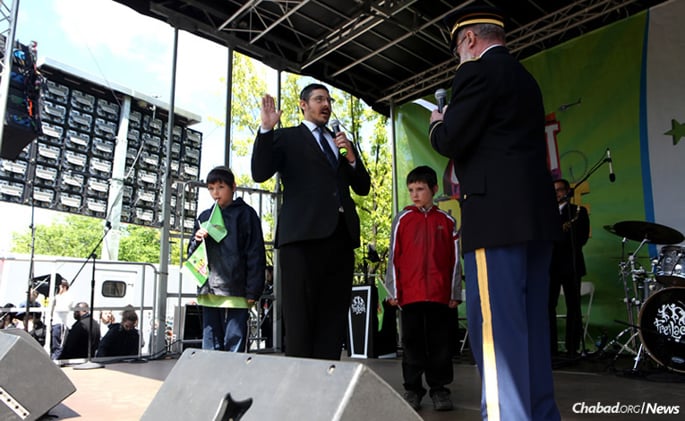
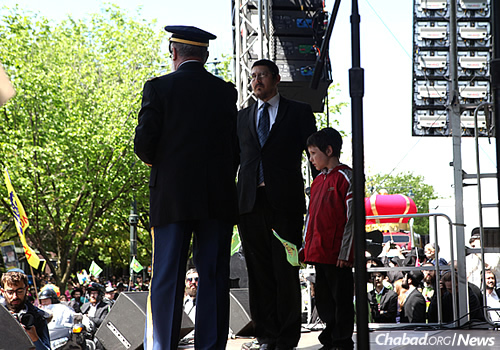
After going through the procedural hurdles of joining the reserve, Madvig reached out to longtime chaplain and rabbi U.S. Army Col. (ret.) Jacob Goldstein, telling him that he would be in the Crown Heights neighborhood of Brooklyn, N.Y., for the annual Lag BaOmer parade. Madvig asked whether he could officiate a “swearing-in” ceremony. Goldstein suggested that they do it during the parade. (Since Judaism does not allow Madvig to take an oath, the rabbi instead “solemnly affirmed” his commitment to duty, he reports.)
“I thought I was going to be nervous up there in front of thousands of people and countless people watching online, but it was almost like no one was there. It was kind of an out-of-body experience,” he relates.
Now he awaits his orders. He has to go through a 90-day training program and then will likely serve at an army base in Williamsport, Pa., which is about three hours south from Oswego.
“My wife is a little bit nervous about the whole training thing. It’s kind of a long time to be away from home,” he says. “But in the reserve, you don’t have to be away so much.”
Estrin, the Air Force reserve chaplain who advised Madvig, says his colleague has the necessary qualities “that will make him a fantastic chaplain.”
“He is a personable, sensitive and passionate person,” affirms Estrin, who serves at a base in Tacoma, Wash. “I’m really, really thrilled for him.”

Related Article:
Meet the Newest Bearded Chaplain in the U.S. Air Force

For trainee and therapist Rabbi Levy Pekar, it’s an opportunity to serve
Related Article:
After Lifting of Beard Ban, Chabad Campus Rabbi to Become an Air Force Chaplain


Very inspiring article, whicj brings me to a subject that has mystified me since living in Crown Heights.
As an American and daughter of a WWII veteran, I am always hurt and disappointed that there is absolutely no public acknowledgement of Memorial Day or Veteran's Day in Crown Heights. Children go to school like a regular Day and there is not even one American Flag outside 770 or on any Chabad Building.
I was walking with a Thai/American friend on Easter Parkway and even he was surprised that there was not a sign of gratitude to those Americans who served/ or died for our country.
Where would jews be today if Germany won the war? What about our younger men and women who give their lives in the Middle East?
As a community Chabad often supports candidates who want a strong ,military, yet there in no public support of gratitude. It just does not speak well of this community. We are all Americans and this day we should join with others publicly to show appreciation for our soldiers.