


Debbie Bensaid has lived in the Central African city of Kinshasa, Congo, for most of her life. She was three months old in 1991 when her parents moved to what was then called Zaire to establish Chabad-Lubavitch of Central Africa, growing up blocks away from the majestic Congo River and amidst the occasional civil war. Different, you might say, from the life of a typical Chassidic girl anywhere else in the world. Yet for her, Africa is home.
“Africa is all I know,” says Bensaid. “The people are friendly; the Jewish community is close and safe. I love it here.”
She remembers what is sometimes called the Second Congo War, in 1998, when as a 7-year-old she and her family took the last plane out of the country that August. “I don’t remember being scared, but you could feel the tension in the country. The streets were empty.”
Her family returned to Congo, but experienced other periods of instability afterwards. Nevertheless, as a Jew, she never felt afraid. “Congolese people are very friendly and nice,” says Bensaid. “They love Jews and have always respected us. We feel comfortable as Jews in this country.”
Now, with her Paris-born husband Rabbi Yerah Bensaid, the young mother of two is preparing to open Chabad-Lubavitch’s newest outpost on the continent: Later this year, the Bensaids will move to Abidjan and establish Chabad of Ivory Coast. Their center in West Africa will be the seventh permanent center under the umbrella of Chabad of Central Africa, joining the neighboring countries of Ghana and Nigeria. A center opened in Uganda at the end of 2017, and one in Tanzania earlier this year.
Ironically, with a three-and-a-half-hour flight connecting Abidjan and Kinshasa (albeit only three times a week), Debbie Bensaid’s new home won’t be all that far from her old one. Beyond the benefit of knowing what life is actually like in Africa, Bensaid says she will draw on the lessons she learned in Congo, where she watched her parents, Rabbi Shlomo and Miriam Bentolila, build a vibrant and loving Jewish community.
“The example I look at is my mother. She created a beautiful Hebrew school, where children learned to read and write Hebrew, and celebrate Shabbat and all the Jewish holidays in a warm atmosphere,” she says. “I hope that my children and all the children of the Jewish community in Ivory Coast gain that same sense of Jewish pride and enthusiasm.”

Rabbi Bensaid, who first visited and met with Jewish community members in Ivory Coast several months ago, says the former French colony (also known as Côte d’Ivoire) is a growing place, drawing businesspeople and investors from around the world. The Jewish community numbers between 200 and 300 people—a mixture of Israelis, Americans and Europeans, especially French Jews, who are involved in a host of businesses, from infrastructure development to oil and gas to commodities.
“We are looking for a suitable place to open Abidjan’s first synagogue, which will also serve as the base of Chabad activities,” he says. “Ultimately, our top priority will be to build a mikvah.”

Three Decades of Chabad
Rabbi Bentolila was a young rabbinical student when he first visited Ivory Coast back in 1988, which was also his first time in Africa. He and another yeshivah student spent a week in Abidjan as part of the Merkos Shlichus rabbinical visitation program, also known as Roving Rabbis, a trip that saw them visit six countries in all and paved the way for the opening of a permanent center. Back then, Ivory Coast’s Jewish community was larger, and they even arranged a significant gathering to mark the completion of the study cycle of Maimonides’ Mishneh Torah, attended by 125 people. Three years later, by this time married, Bentolila settled in Kinshasa, and has maintained a strong relationship with the Ivorian Jewish community ever since, regularly assisting them.

Fueled by rapid infrastructure development, a large Jewish community flourished in Abidjan in the 1960s; by 1973, there was even a Jewish day school, which at a point drew 300 children. Igael Cohen was born in Abidjan in 1973 and recalls those days warmly, but, he says, most people left in the early 1990s, when the country became less and less stable. After growing up in Ivory Coast, where he attended the Jewish school, Cohen lived in France for a time before returning to Abidjan in 1994. Jewish life there, he says, has benefited greatly from the close attention it has received from Chabad of Central Africa.
“I know Rabbi Bentolila for many years. He visited often, and he’d send yeshivah students from all over the world for all the Jewish holidays,” he says. “It is always a very soulful experience, and brings me and everyone here great happiness.”
Until now, Ivory Coast was one of 11 African countries without a permanent Chabad center, serviced by Chabad of Central Africa. Another one is the Republic of Congo (as opposed to the Democratic Republic of Congo, where the Bentolilas live), which is where Efraim Meslet first came in contact with Chabad on the continent. Originally from France, Meslet and his family immigrated to Israel 15 years ago, but he has been doing business in Africa since 2011. Before coming to Ivory Coast, he was spending a few weeks of every month in Brazzaville, the capital of the Republic of Congo. While just across the river from Kinshasa, it is a world away.
“It is a crazy adventure to cross the river,” he says. The Jewish community there tried organizing regular activities, but would always get a boost when young men with matzah arrived for Passover or menorahs and doughnuts for Chanukah. “I saw their ability to find Jews lost in the jungle. It was amazing.”
Taking the Jewish Community to the Next Level
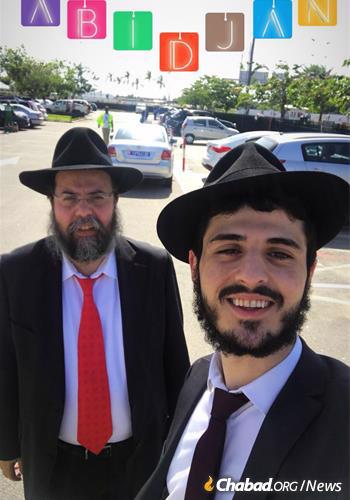
Now in Ivory Coast, Meslet says that a permanent Chabad presence will allow the Abidjan Jewish community to go to the next level. “I think it’s very needed,” he says of the Bensaids’ impending arrival. “They will give us a place to gather; we need a good Jewish home. And I think more and more people will come here if we do have that.”
Amnon Razin is one of the pillars of the Ivorian Jewish community. Like the others, he, too, recalls the impact Chabad had upon another small community he once called home. In the 1970s, after the capture of the Sinai from Egypt in 1967, he lived in and was secretary of the tiny town of Neviot (now Nuweiba) in the Sinai peninsula. One problem the community faced was a lack of traditional Jewish education for their children—that is, until volunteers from Chabad of Eilat, some 80 kilometers north, began visiting the town and teaching their kids.
“They were fulfilling an important task there, and we all appreciated it very much,” says Razin. “I think the same thing will happen here. The community is not very big, but when someone is away from their country, away from their culture, you become thirsty for these things, for Torah, for tradition. So Chabad is going to bring what we really are missing.”

Razin, who first came to Ivory Coast to work on transforming the country’s driver’s license system from a paper one to a credit-card-sized biometric type, and has since moved on to other projects, also notes the growing number of opportunities in Ivory Coast. He says that more Israelis are being drawn to Africa in general because of the new markets hungry for technology, and other products and services.
There is also a sense that the recent stability Ivory Coast has enjoyed will stick. Many French companies have begun returning and reinvesting in the country, which is a good sign. The progress will ultimately be put to the test during the next elections, slated for 2020. “I have a good opinion on what is going on,” says Cohen.
“This felt very much like the right time to send permanent emissaries to Ivory Coast,” says Bentolila, who also credits the recent surge of permanent emissaries in Central Africa to the assistance of Rabbi Moshe Kotlarsky, vice chairman of Merkos L’Inyonei Chinuch, the educational arm of Chabad-Lubavitch. “It’s a little Paris, a beautiful little country, and we believe its future—Jewish and otherwise—is a bright one.”


You guys are so crazy great! Who can believe what you accomplish. The Rebbe is so proud of you! I am so jealous of you! May The Congolese be blessed for their love and hospitality towards you. May you continue to enjoy your shlee’choos