


Winding alleyways make their way past carved doors before spilling into crowded marketplaces. Zanzibar, today an autonomous part of the East African country of Tanzania, was once, not too long ago, a Sultanate. The island—23 miles off the African coast and colored by generations of Arab, Indian and European influences—has seen tourists flock there in increasing numbers, drawn not only by the exotic history but by the pure white beaches, licked by a brilliant cobalt sea.
Tourism has multiplied by a factor of 20 since the 1980s, and this past year nearly 400,000 foreigners traveled to Zanzibar. Among them, of course, are Jews, including thousands of Israelis. Zanzibar is one of only two sub-Saharan African countries with direct flights from Israel.
“We have been arranging for rabbinical students or young couples to travel there for holidays for the last five to six years,” says Rabbi Shlomo Bentolila, who directs Chabad-Lubavitch of Central Africa in the Congo. “There has never been a local Jewish community in Zanzibar, so it has always been about catering to the needs of the varied Jewish travelers.”
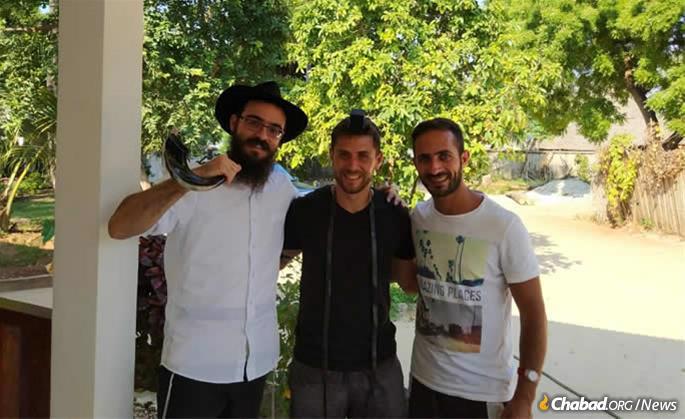
Seeing the rapid growth and potential for creating a Jewish environment where none existed, Bentolila enlisted Israeli-born Rabbi Shneor and Mushka Shmulevitz—together with their 8-month-old son, Menachem Mendel—to establish Chabad-Lubavitch of Zanzibar. They set up shop on the island earlier this year.
Tourist numbers continue to grow, and aside from the two months of monsoon season, roughly April to May, they are a constant presence. Unlike those visiting the many Chabad outposts geared to Israeli backpackers—such as in Cusco, Peru or Kathmandu, Nepal—Jewish visitors to Zanzibar are mostly vacationers, people spending a week in an affordable paradise, and Chabad is located in the popular coastal resort town of Nungwi. It is not only Israelis traveling there, with tourists coming from the United Kingdom, Europe, South Africa, Australia and the United States. Aside from the tourists, there are handfuls of Jewish business people, representatives of NGOs and diplomats who live there full-time.
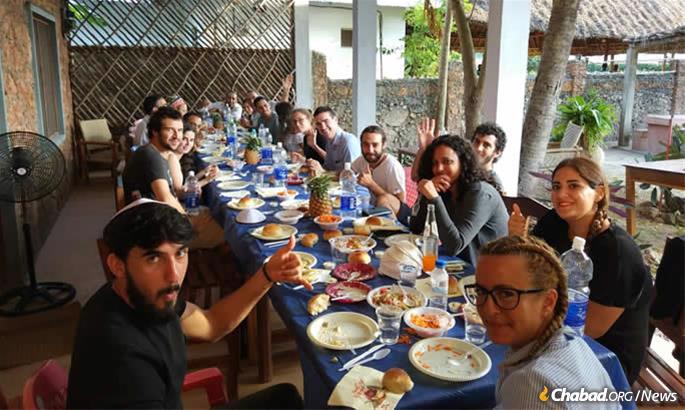
Hosting Hundreds for the Holidays
Since many Israelis have vacation time around Jewish holidays, they are a particularly popular time for visitors, says Shmulevitz, whose Rosh Hashanah drew 200 guests a year ago, as did the palm-leaf-covered sukkah and beachside Passover seder.
There is little in the way of kosher products, most of which Shmulevitz has shipped in from Israel, but the basics are there: rice, flour, fruits and vegetables, and, of course, fish. Zanzibar has an abundance of seafood, with fishing villages dotting the coasts, so kosher varieties are a basic staple at the Jewish center, with Shmulevitz going down to the waterfront to purchase tuna or mahi-mahi.
Zanzibar is 99 percent Muslim, but Shmulevitz says that he and his family feel safe there, as do Jewish travelers.
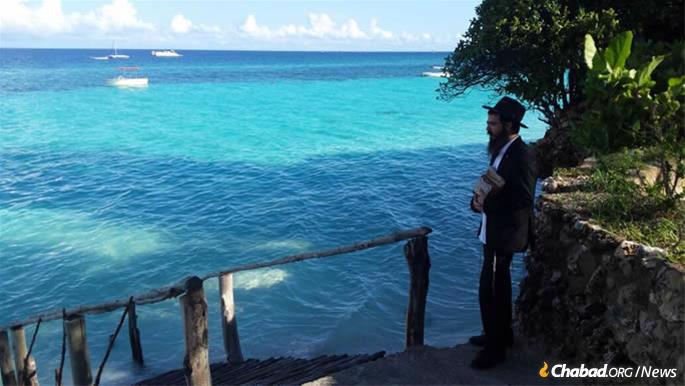
“The locals here respect religious people very much,” says the rabbi. “When they see me walking in my garb, with a kippah, my beard, tzitzit, they’re very respectful.”
Not familiar with the word “rabbi,” some locals have even taken to calling him “Sheikh Shneor,” he says.
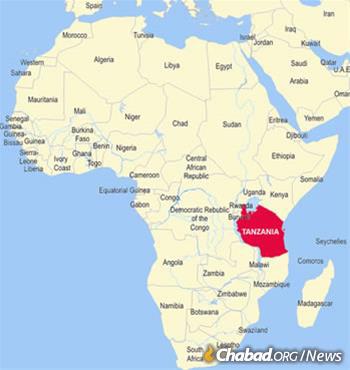
While Zanzibar has, to anyone’s knowledge, never been home to a Jewish community—Chabad’s Yom Kippur services there last year may have been the ancient island’s first-ever—the mainland of Tanzania does have a small one, with about 50 Jews living in its most populous city, Dar es Salaam, which has been getting Chabad rabbinical students for more than a decade. There are also many Jewish tourists to Serengeti National Park. While Chabad of Central Africa has been directly caring for their needs until now, the Shmulevitzes will take on a larger role in that respect as well.
The tourist areas may be ritzy and new, but there is another side to Zanzibar: a pervasive poverty and underdevelopment.
“There is a huge disparity between life in the resorts and in the villages,” says the rabbi. “You cross over one centimeter past the tourist area, and you’re in a different world.”
Although aspects of daily life in Zanzibar are difficult, more difficult than the couple imagined, the Shmulevitzes are thankful to be sharing the message of the Rebbe—Rabbi Menachem M. Schneerson, of righteous memory—in this distant part of the world, establishing Jewish life in a place none ever existed.
“It’s hard, but we’re not suffering,” says the rabbi. “We feel lucky to be here.”



Shalom
Am so glad that there is jewish presence in our country
Iam Gideon living in Dar es salaam i real neee to learn Hebrew can you help me to learn if you will