


Congressman John Lewis was a man who sought what was right, just and moral. Born the son of poor black sharecroppers in 1940 in rural Alabama, it was this pursuit of G‑dly values that saw him write to Dr. Martin Luther King Jr., asking to join him in the fledgling civil rights movement. King responded to the 18-year-old Lewis with a bus ticket to visit him in Montgomery, Ala., and, in a few years, Lewis would be marching at his side.
As a student of King’s, Lewis, who passed away at the age of 80 on July 17, was a lifelong proponent of nonviolent protest and became a civil rights icon in his own right. His first arrest in the battle for equal rights for blacks in America came in February 1960, when he and a group of students calmly sat down at a “whites-only” lunch counter in Nashville, Tenn., and demanded service like anyone else. Over the next six years, he would be arrested another 40 times, and “repeatedly beaten senseless by Southern policemen and freelance hoodlums,” The New York Times reported. During the Freedom Rides in 1961, he was “left unconscious in a pool of his own blood outside the Greyhound Bus Terminal in Montgomery.” Four years later, during a peaceful march for voting rights in Selma, Ala., images of Lewis’s skull being cracked open by state troopers would rocket around the country.
And it was this same innate sense of morality that led the deeply religious Lewis, who was elected to the U.S. House of Representatives from Atlanta in 1986, to take inspiration from the teachings and impact of a Jewish leader whose moral vision and leadership deeply moved him.
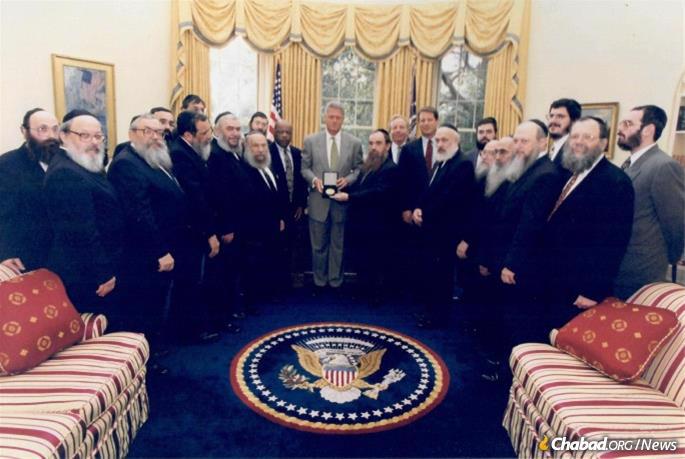
In 1994, the staunch Democrat Lewis would become one of the sponsors of the bill bestowing the Congressional Gold Medal for the Rebbe, Rabbi Menachem M. Schneerson, of righteous memory, together with arch-rival Congressman Newt Gingrich.
“He not only backed that historic effort, he was one of the people who actively explained to others the merits of awarding this to the Rebbe,” recalls Rabbi Levi Shemtov, executive vice president of American Friends of Lubavitch (Chabad) in Washington, D.C.
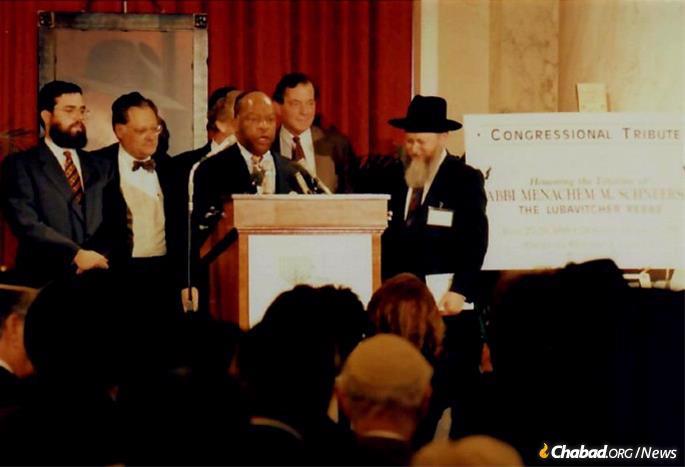
In his moving words at the awards ceremony, Lewis noted that there was “almost nothing, nothing at all” that he and Gingrich agreed on, but that this medal—the Rebbe became the first to receive this award for spiritual leadership—brought the two ideological opponents together. “It brought Democrats and Republicans, liberals, conservatives, Northerners and Southerners, blacks, whites and Hispanic, it brought us all together,” he said.
The medal, approved unanimously by both houses of Congress and then presented by President Bill Clinton at the White House, was awarded to the Rebbe months after his passing in June of 1994.
“We may no longer see the Rebbe with our eyes, but his spirit lives in our hearts, in our souls and in our deeds,” Lewis said at the event. “The Rebbe, like my mentor Dr. Martin Luther King Jr., worked every day of his life, to be what Dr. King used to call ‘the beloved community,’ an all‑inclusive community, a community at peace with itself, a country and a world in which people were not judged by the color of their skin but by the content of their character. The Rebbe judged people by the content of their character and he worked every day to make this world a better world. ... I am sorry to say that I never got to meet the Rebbe. I know I would have liked him. I know Dr. King would have liked him.”
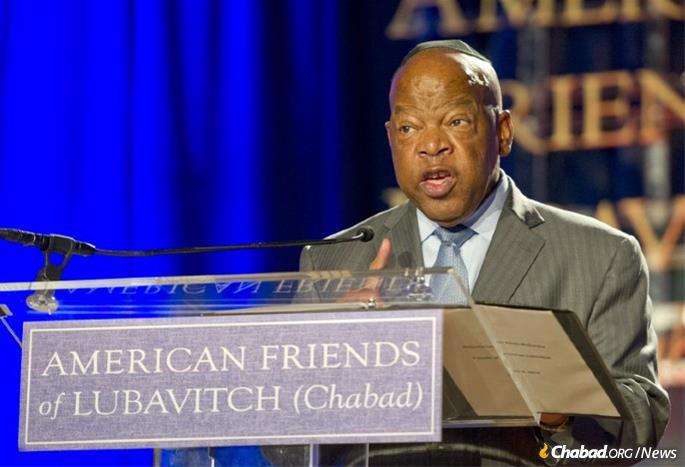
“Not everyone agreed with Congressman Lewis all the time, but everyone respected him, and it went both ways—he respected those with whom he disagreed as well,” reflects Shemtov, whose organization honored Lewis at their gala dinner in 2009. “On a personal level, he was a true mensch and a great man. He will be sorely missed.”

Never Lost Faith in Nonviolence
Lewis never lost his faith in nonviolence. On the 50th anniversary of the Selma march, Lewis invited Shemtov to discuss the Rebbe’s thoughts on the meaning of freedom. During the conversation, Lewis recalled King’s encouragement of love as the only viable path forward, even in the aftermath of the violence unleashed on peaceful marchers; Lewis would stick to these principles through thick and thin. Lewis also consistently and forcefully rejected hate emanating from all quarters, including his famous condemnation of Nation of Islam leader Louis Farrakhan. “There’s not any room in our society for the teachings or preachings of any doctrine or philosophy of racism, bigotry or anti-Semitism,” Lewis told The Baltimore Sun in 1994 in reference to Farrakhan, when he refused to join the latter’s Million Man March.
“John Lewis stared down the worst of humanity using the best of humanity,” says Shemtov. “Namely, defeating weaponry and bigotry with the unbreakable strength of the human spirit.”
It was something Lewis believed all of humanity could accomplish, together.
“Working together, we can accomplish great things,” Lewis said at the 1995 event in honor of the Rebbe. “Together we can build a better world, a more united world, a more peaceful world. It is a world the Rebbe devoted his life to create. We must carry on his work. We all must keep our eyes on the prize.”


This is beautiful! May God's Blessings rest upon everyone!