

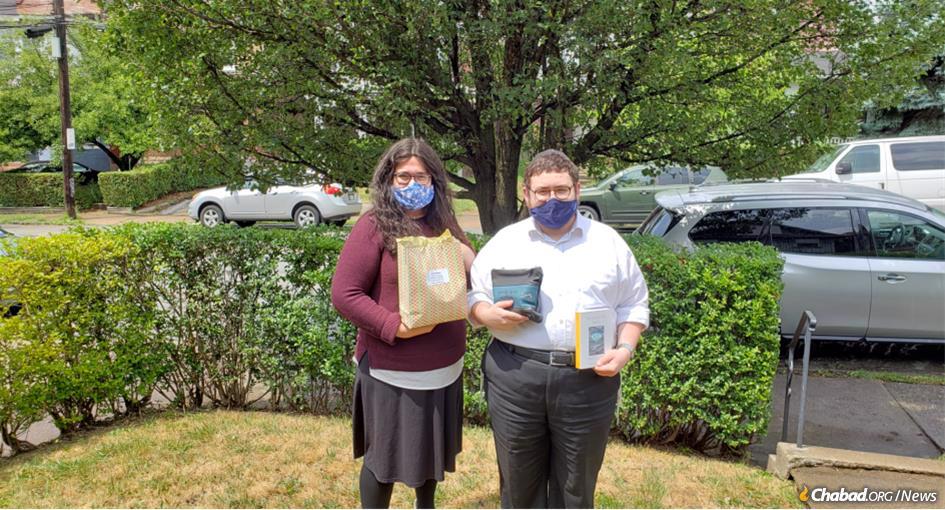
A global pandemic has swept over the world, and to many, the future seems murky and unsure; planning past tomorrow feels impossible. But for the new Chabad-Lubavitch emissaries who have taken up their posts since the coronavirus began to spread, now is the perfect time to start building the future, and those living in the communities that they will be serving could not agree more.
Last year, more than 100 new couples joined the ranks of Chabad-Lubavitch around the world, and Chabad has continued to expand throughout the pandemic in the first half of 2020, with some joining established Chabad centers and others moving to communities where there was no permanent Chabad presence.
Typically, when a new couple moves to a city, the first step is to begin networking and meeting people. But there is no compromising on health guidelines, and as long as social distancing is the required norm, the traditional meet-and-greet is not always possible, says Rabbi Yossi Feller, who, together with his wife, Leah, is opening a Chabad center in Cranberry Township, Pa., about 20 miles due north of Pittsburgh. Without the option of typical get-togethers, the Fellers have resorted to the good old-fashioned phonebook to get acquainted with the Jewish community there—and it turns out people still answer the phone.
Dr. George Goodman is one local resident for whom the new Chabad couple is a dream come true. Goodman is a pulmonary and critical care physician in the hospital right near Cranberry Township. At 69, he is semi-retired, but occasionally sees patients in intensive-care units and consults in the local hospital. Although he has only known the Fellers for a few weeks, he points out that the journey to finding them spans decades, perhaps a lifetime.
Goodman was raised by American globetrotting parents. His early childhood in the 1950s and ’60s was spent in various Central American countries. “Both my parents were very culturally Jewish. The Holocaust was the prism from which we viewed the world. And when they wanted to say something private, it was always in Yiddish,” he told Chabad.org. Jewish literature, music and theater were central in Goodman’s home, but they never went to synagogue and never stayed in one place long enough to become part of a community.
While in junior high school, Goodman attended Hebrew school and trained to have his bar mitzvah. Keenly aware of his Jewish identity, he took his studies seriously and excelled in them. But when his 13th birthday approached, the family was overseas, and his Jewish studies were put on hold. For 40 years, they remained that way, he recounted, until he began to explore Judaism 12 years ago.
Recently, Goodman learned that a friend of his had discovered a Chabad House an hour’s drive away from his home. “George,” he said, “you ought to see what’s going on here. I found the future of Judaism.”
So he went to visit Chabad of South Hills, despite the long drive, to attend some weekday classes, and he was pleasantly surprised to find that he felt he belonged and was welcomed there, in an otherwise strange setting with Orthodox customs he was not familiar with. A few weeks later, a different friend sent Goodman a link. It was an article announcing the Fellers’ upcoming move to Cranberry Township, and an email to reach the Fellers. It was an answer to all that he wished for.
“I emailed Rabbi Feller, and within 24 hours I had a response. Just last week, I had Shabbat dinner with his family and was delighted by their idealism and burning passion to share their knowledge. I am grateful that I will soon have a place where I can be a part of regular prayer services and intake a steady diet of Torah study and discussion,” he said. “I am hoping to be in the presence of other Jews who share my values and beliefs. And from every conversation I’ve had with Rabbi Feller so far, I am convinced that he wants the same.”
“As Chassidim, we know that everything is hashgacha pratis, Divine providence,” says the rabbi. “Nothing is by chance. These circumstances may not be as we planned, but G‑d planned it this way for a reason. So we’re not going to throw our hands up in defeat; we’ll make the best of it.”

Inspiration in Difficult Times
In starting out during difficult times, the Fellers say they are following the example set by their role model, the Rebbe—Rabbi Menachem M. Schneerson, of righteous memory. When trying to overcome obstacles in founding the Chabad Center due to the coronavirus, Feller turns to the published letters of the Rebbe for inspiration.
“The Rebbe was living in Berlin and Paris as anti-Semitism squeezed its ugly chokehold on Europe,” he related. “He experienced global upheaval that could have understandably stopped him from fulfilling his mission. But the Rebbe’s presence was consistently positive, and he refused to let any external circumstance stop him from doing what he must. Now, we, too, must hold onto our faith and move forward.”
Elsewhere around the country, Rabbi Shmully and Miny Ceitlin will be the 52d couple in the state of Texas, serving in the Torah Day School and regional Chabad headquarters. In upstate New York, Rabbi Levi and Frumi Charitonow are establishing a new Chabad House in Utica, and across the country, Rabbi Meir and Sheina Posner have moved to Portland, Ore., where they will be working with young professionals and serving the community in Portland's Northwest neighborhood. A number of couples are starting out in Israel, the former Soviet Union and elsewhere around the world as well.
“We expected one thing: Planning big social events,” says Rachel Lapidus, who together with her husband Levi and baby Dov, recently moved to Atlanta to run multiple outreach activities for Chabad Intown. “We were looking forward to welcoming lots of people into our home for Shabbat. Teaching learning classes to overflowing crowds,” she continued. But the pandemic made that impossible, and Lapidus realized the only way she and her husband would succeed is if they totally shifted their paradigm.
“The pandemic forced us to reframe what shlichus is really all about. We started reaching out to individuals. Learning with people one-on-one. We rediscovered the power of basic human connections, and if it weren’t for this pandemic, perhaps we never would have found this focus.”
Channeling their frustration into faith, the Lapidus family has successfully launched their first outreach programs for the Young Jewish Professional community of Intown. Looking forward to the High Holidays, they are planning a “Slacker Service” that will include pre-packaged apple-and-honey treats, a brunch-to-go, a short service with the blowing of the shofar, and outdoor socially-distanced-mingling for their growing crowd of young professionals.

‘A Spiritual, Social, All-Encompassing Lift’
Joining the Fellers in Western Pennsylvania are Dovie and Mushkie Kivman, who are moving to Erie, Pa., with their little son, Yossele. Seven months ago when they decided to establish a Chabad Center, they could never have imagined an invisible virus putting all their plans on hold.
Back in January, they visited their future hometown and began to make acquaintances, connecting with the Jewish community of Erie and reaching out to unaffiliated Jews. On Purim, they hosted an intimate holiday event full of joy and laughter, and read the Megillah, which tells the story of G‑d turning everything upside down.
Just days later, G‑d did indeed turn everything upside down.
“We haven’t been able to return to Erie since the outbreak of COVID-19,” says Dovie Kivman. “But we also can’t push off moving there until the crisis is over, because nobody knows when this will be over. So we are finding ways to serve the community that we wouldn’t have thought possible before.”
The Kivmans are in the process of renting a home in Erie that they have never stepped foot in. Thanks to the digital marketing of real estate, they were able to examine different options and settle on one that’s right for them. They are also forming meaningful relationships with community members using FaceTime and Zoom to bridge the physical divide.
“Our motto is: ‘A rising tide lifts all boats.’ We want to bring a spiritual, social and all-encompassing lift to our community. At a time like this, when so many people are drowning in worry, we feel the need of a Chabad presence in Erie even more urgently.”

‘How They Enrich Our Jewish Community’
Both the Fellers and the Kivmans, who are working under the auspices of Rabbi Yisroel Rosenfeld, who directs Chabad-Lubavitch in western Pennsylvania, have seen a fascinating phenomenon. Although their ability to reach out to Jewish community members is largely limited because of the pandemic, people are instead turning to them. Requests are pouring in from those who read articles about the new shluchim online. Prayer gatherings. Private learning sessions. Shabbat meals. Anticipation is growing; people are thirsting to connect.
Mark Tenanbaum, executive director of PACA, the Performing Arts Collective Alliance in Erie, is a die-hard fan of the place where he was born and raised. “I love seeing an increase in Jewish involvement in this amazing city,” he said. “I met the lovely Kivman family before the pandemic and look forward to seeing how they enrich our Jewish community.”
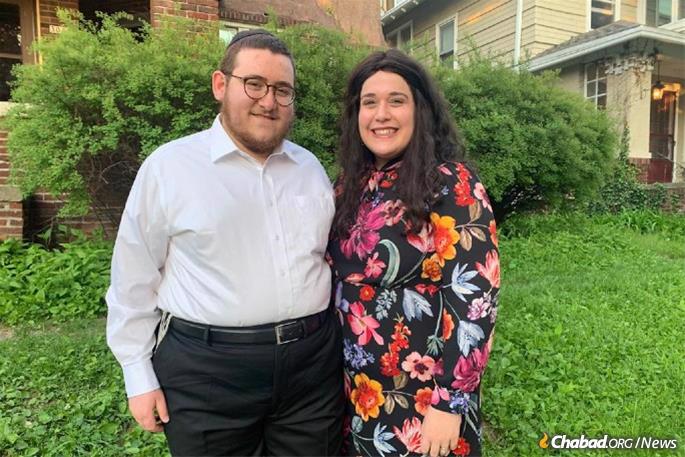
Coronavirus cannot cancel the High Holidays; that’s the only thing the Fellers and the Kivmans know for sure. Everything else—What will government guidelines look like in September? Will outdoor events be permissible? Can food be served? Is it best to rent a tent for outdoor services?—remains up in the air for now.
Feller’s method of planning the High Holidays is to start from what he does know—that Jewish families and individuals from Cranberry Township have emailed that they are hoping for services during the Days of Awe. The need is there. A generous sponsor has provided prayer books and prayer shawls for the community. The supplies are there. Feller is in touch with a chazzan who is ready to accommodate any safety guidelines, be it quarantining beforehand or wearing a mask during the prayer services. Everything that can be is there. Now, they wait for government guidelines to let them know what will be possible for a safe and spiritual High Holidays.
“At times like these, it’s important to remain flexible,” said Rabbi Kivman in summary of his experience building a Chabad center during the pandemic. “Everything is always in G‑d’s hands. Now we just see it a little more clearly.”



This is an exciting article about these Chabad Emissaries and it goes to show how Great G-d is
Baruch Hashem and how their reaching out to there community in very thoughtful and exciting ways wow keep up the good work Baruch Hashem!