

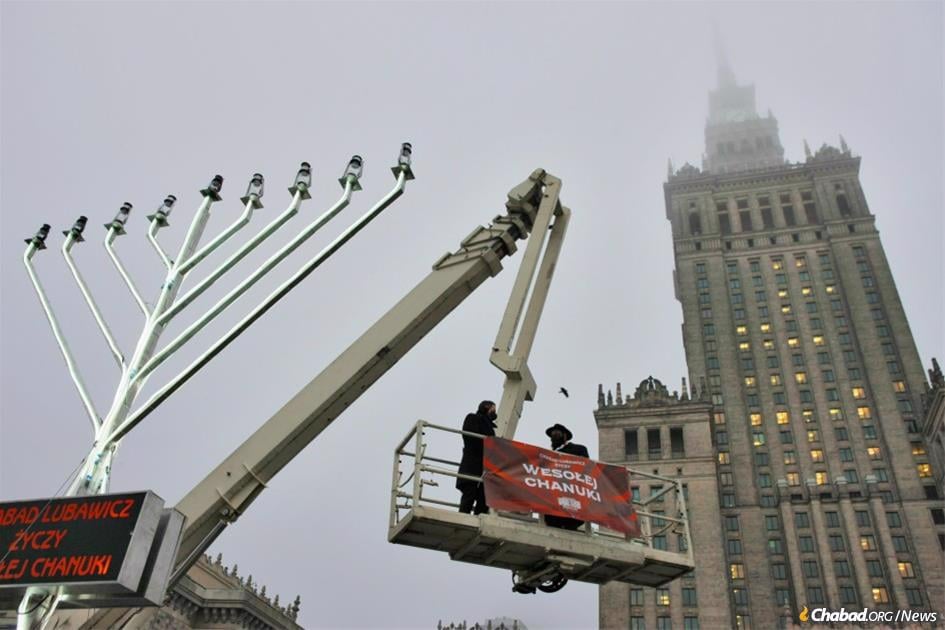
For Warsaw Mayor Rafał Trzaskowski, the lighting of the 20-foot-tall public Hanukkah menorah in front of the towering Palace of Culture and Science in Warsaw completes a circle. Reading about the ceremony some 1,300 kilometers to the west in Amsterdam, it did much the same for Polish-born Eva Stokx-Gruber.
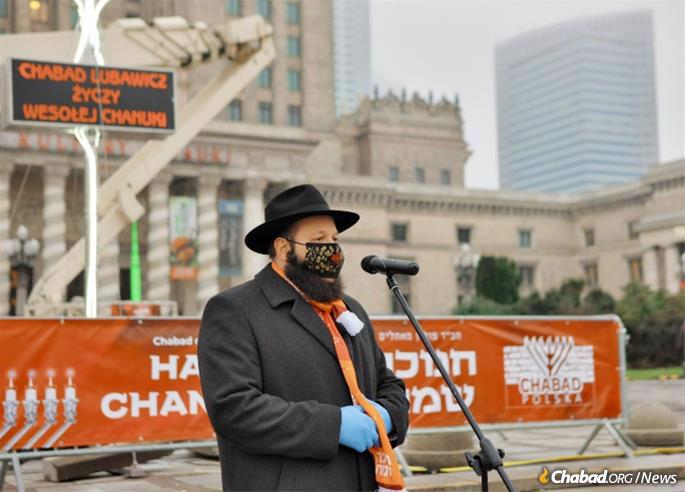
On Friday afternoon, the early onset of the second evening of Hanukkah, the 48-year-old Trzaskowski joined Rabbi Sholom Ber Stambler, director of Chabad-Lubavitch of Poland, in kindling the giant menorah in front of the capital’s Palace of Culture. The significance of the lighting was not lost on the mayor, a young political leader in a country laden with 1,000 years of triumphant and tragic Jewish history.
Ninety-two years earlier in a very different Warsaw, the Rebbe—Rabbi Menachem M. Schneerson, of righteous memory—married Rebbetzin Chaya Mushka, the middle daughter of the Sixth Rebbe—Rabbi Yosef Yitzchak Schneersohn, of righteous memory. The chuppah ceremony was held in the courtyard of Yeshivah Tomchei Temimim in Warsaw, while the grand wedding reception took place just a stone’s throw away from where the Palace of Culture now stands, at a hall that once occupied Pańska 35.
“All this happens,” Mayor Trzaskowski noted about the menorah-lighting, “thanks to Rabbi Menachem M. Schneerson, who is known as the most influential rabbi in contemporary history.”
The Rebbe launched Chabad’s Hanukkah awareness campaign in 1973, and in the decades since it has grown in size and scope, revitalizing the modern observance of the Festival of Lights. Today, there are 15,000 public menorahs dotting the globe from Washington, D.C., to Paris, to Moscow, and, for the last 15 years, Warsaw.
“We have already gotten used to it that it is celebrated practically all around the world, but we are especially proud because it all started in our city, Warsaw,” stated Trzaskowski. “It was here … [that] the Rebbe married the daughter of his predecessor and everything … that he did for humanity started … . These lights closed the circle, coming back to the place where it all started, to Warsaw.”
If in some parts of Europe old buildings serve as reminders of the rich Jewish life that once was, in Warsaw it is their utter absence that stands out. The synagogues, study halls, schools and orphanages are all gone, just like virtually all of Warsaw’s pre-war population of 400,000 Jews—destroyed, along with the rest of the city, by the Nazis and their collaborators.
Following World War II and the Holocaust, Poland, along with the relatively few Jews who returned there, fell under the boot of Soviet Communism. In fact, the Palace of Culture that serves as the menorah’s backdrop over the eight days and nights of Hanukkah and is Poland’s tallest building, was gifted to Communist Poland by Soviet despot Joseph Stalin in 1952 and completed three years later, after his death.
“Stalin built a monument here for himself that outlasted his life and his time,” says Chabad’s Stambler, whose Hanukkah activities included a live-streamed musical holiday program, as well as sending out menorah-and-candle kits throughout the country, including to Jewish prisoners. “The Palace of Culture was for so long a center of darkness. Today, the menorah stands at that very place to share the message of faith, tolerance, religious freedom and the power of light.”
Recalling Darkness, Seeing Light
For Eva Stokx-Gruber, 63, a Polish-born Jew living in Amsterdam, the darkness that once emanated from the Palace of Culture is not a lesson learned from history books. When a friend in Poland sent her a link to a news story about Chabad’s Warsaw menorah-lighting and the mayor’s warm participation, it was the contrast with her own memories of the country’s post-war anti-Semitism that moved her most.
Stokx-Gruber was born in 1957 to Holocaust survivors in Warsaw. Her mother was from the capital city and managed to stay hidden for much of the war before being handed over to the Nazis by her Polish neighbors. Sent to Auschwitz, her siblings perished, but she survived. Stokx-Gruber’s father, who made it through the war fighting with the Red Army, was from Złoczów, Poland, (today, Zolochiv, Ukraine), and was a descendant of the saintly R’ Michel Zlotchever (1721?-1786), a disciple of the Baal Shem Tov. It was both of her parents’ deep roots in Poland that led them to remain there after the war, where they met and married.
By the time they recognized the distinctly anti-Semitic bent of Poland’s Communist regime, it was too late. They did not manage to gain permission to leave during the Polish Jewish exodus of 1956, and Stokx-Gruber grew up in an oppressively anti-Jewish atmosphere.
“My mother survived the war because she ‘looked good,’ which means she did not look classically Jewish,” recalls Stokx-Gruber. “But my father and I, we both did not ‘look good.’ We looked very Jewish.”
Things came to a head in the aftermath of the Six Day War in 1967. “We cannot ignore the people who, when facing a threat to world peace and Poland’s security and peaceful operation, take the side of the aggressors, the havoc-wreakers and the imperialists,” Poland’s leader Władysław Gomułka declared in the Congress Hall at the Palace of Culture about “Zionist-Jewish circles.” He added that “we do not want to have a fifth column in our country.”
“Gomułka said it was time for the Jews to leave Poland from the same exact place where the menorah stands, from the Palace of Culture,” recalls Stokx-Gruber.
The anti-Semitic intrigues intensified in 1968-69. Her father took the hint, and in 1969, at the age of 59, moved his family to the Netherlands. Stokx-Gruber was 13 at the time and has lived in Amsterdam ever since. Today, Stokx-Gruber proudly reports, her family is not only alive but Jewish.
“Our ancestors remained Jewish for thousands of years, who are we to finish it off?” she asks rhetorically. “My children are Jewish, my grandchildren are Jewish—my grandson goes to Sunday Hebrew school here at Chabad of Holland. Hitler wanted to destroy us, but he couldn’t.”
Seeing the giant menorah on the steps of the Palace of Culture in the heart of Warsaw—with the participation of the city’s mayor no less—brought something out in her.
“It was very emotional for me,” says Stokx-Gruber. “They wanted Polish Jewry to cease to exist but we are still there, in Warsaw, too.
“Am Yisrael Chai!—The Jewish People lives!”






I lived in Warszawa for a while, and I’m happy learning of this Chanukah event this year. Congratulations to all the Polish Jews!