


Tzvi Holt, 40, is a staff sergeant in the Vermont National Guard and a full-time military man. He’s also an observant Jew and the father of four girls. This February, the long-serving soldier received a promotion to the rank of staff sergeant. Holt isn’t a military chaplain, despite being an ordained rabbi and sporting a full, untrimmed beard. He’s a career soldier, currently serving in the Vermont National Guard’s Counterdrug Task Force.
Holt wasn’t always a bearded Chassidic soldier. In fact, he was born Steve Holt, son of a Protestant minister in Burlington, Vt. As a child, he said he had many questions; Bible study left him questioning his faith and even G‑d. “I remember being a little 8-year-old in Sunday school asking, ‘Why don’t we do all the things the Israelites did?’ ”
Holt tells Chabad.org, “They would say, ‘Well, this guy came along, and he’s G‑d, and we don’t do any of that stuff anymore.” But these answers never satisfied Holt.
As he grew older, he only grew more confused. “I still wrestled with these questions. Why? How is this thing right? How does this make sense? I saw these contradictions and didn't understand it.” With nowhere to take his questions, Holt figured that if his faith was “a sham,” then so was G‑d. “Maybe He doesn’t exist,” he considered.
In college, he found himself reading the book of Job intently. “I was blown away by the fact that Job’s belief in G‑d had no pretext. Everything comes from G‑d; everything good comes from G‑d, even if it doesn’t seem good right now.”
The book spoke to him, he said: “I felt that this is how I should feel about things. Enough with the Atheism.” Holt now believed in G‑d but wasn’t sure what to do about that belief.
His feelings festered for about a decade until after he began his military service. “I said to myself, ‘You’ve got to figure this out, let’s go back to the beginning.’ ”
So Holt began to look back into these Israelites that piqued his curiosity in Sunday school. “It involved a lot of Google searching, a lot of Chabad.org.” Holt’s father took his son’s seeking seriously and introduced him to a local rabbi he was acquainted with. He began to pursue non-Orthodox conversion; but still, Holt said, it didn’t feel authentic. “I didn’t feel like I was learning a lot; it was more about showing up and being part of the community.” That wasn’t what Holt was after. “I needed to know what I am supposed to do. What are the practical things that manifest this internal belief?”
Transformative Meeting With a Chabad Rabbi
Eventually, Holt approached Rabbi Yitzchok Raskin, co-director of Chabad of Vermont. After much back-and-forth, and the rabbi’s best efforts to dissuade Holt from converting, Raskin saw he was serious and sincere. Liaising with the beit din (“rabbinical court”) in Boston, Holt began to study. As he grew more knowledgeable, he attended YeshivahTiferes Bachurim in Morristown, N.J., where he delved into Judaism on a more advanced level.
All this time, he was still serving in the military, and in and out of the yeshivah. After 20 months of intensive study, he took the plunge into the mikvah and completed the conversion process with the beit din. It was before Rosh Hashanah of 2014, and Holt could now finally sit in the synagogue and pray as a Jew. “It wasn’t ‘for fun’ anymore; I wasn’t buying a lulav and etrog to practice. This was the real deal.”
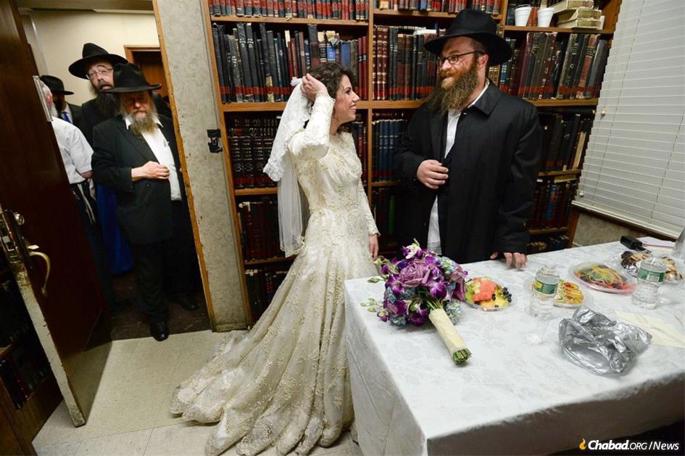
Not long after, while on a trip to Israel, Holt’s friend, Binyomin Murray—today a Chabad rabbi in Middlebury, Vt.—offered to set him up for a shidduch (“match”) with his wife’s friend. At the same time, Holt’s hosts in Israel suggested the same young woman. He had a good feeling already. They dated for several months and then got engaged. As is the Chabad tradition, Holt and his fiancée went to the resting place of the Rebbe—Rabbi Menachem M. Schneerson, of righteous memory—to pray for a happy life together. With his fiancée, Esther Ita Hirschhorn, he was accompanied by his father, who was captivated by the experience.
After marriage, the couple settled in Morristown, N.J., where Holt continued his studies for several years. In 2018, they moved to Vermont, where Holt rejoined the National Guard full-time. It didn’t come without its challenges, though. Holt insisted onkeeping his beard untouched, as required by Jewish law, which didn’t fit the military dress code. His unusual request went all the way to Washington, where it reached the desk of the U.S. Secretary of the Army. Ultimately, his beard was approved, and he made history as the first bearded Vermont Guardsman. He was assisted by others who didso in other military branches before him, such as Rabbi Mendy Stern of the U.S. Army.

It came with a caveat: Holt wouldn’t be able to resume his duties as a member of the chemical and biological threats unit, as his face would need to be tightly covered by a gas mask, and the beard would interfere with that. But that didn’t stop him; after two years of pushing for his beard (longer than conversion took, he laughs), he wasn’t going to give up now. He transferred to an administrative position within the military.
Holt’s military career is in his blood. His family has been serving for as long as America has been a country, and this was the path he’d pursue, challenges notwithstanding.
The military has been supportive of his faith, he said. “It’s a small group; they get to know you. If a curveball comes up in your life, they’ll work with you.”
One such curveball was Shabbat and holiday observance. Generally, Holt has off on Shabbat and holidays, but last year, in the thick of the High Holiday season, his superior warned him he might not be able to take so many days off. Holt works in the finance department, and is responsible for the annual budget of the Vermont National Guard’s Counterdrug Task Force. That year, the military’s end of financial year collided with the days of Simchat Torah and Shmini Atzeret, and Congress still hadn’t passed the budget. He might have to stay on duty to be there as soon as Congress passed the budget.
But Holt wasn’t going to drop his faith overnight. “I told my supervisor that if it comes down to my job or religion, it’s my religion. I won’t be here on Wednesday.” They looked at him askance; that just wasn’t an option. Holt called the State’s finance office, pulling every string he could. After some digging, he found out that the earliest Congress would meet on the budget was after the holiday. His job was safe.

Holt credits the Aleph Institute for making it easier to live as a Jew in the military. “Anytime you need them, they’re there for you. They’ve been amazing.”
His 15 years of dedicated service hasn’t gone unnoticed by his superiors. In February, he was promoted to staff sergeant, which is higher than half of all enlisted ranks.
Holt says he learns a lesson from military service in his own service of G‑d: “In the military, you do what you’re told, whether you understand or not. There is a time and place to question, but ultimately, you need to follow orders. That’s how we serve G‑d, with unquestioning loyalty.”


What a wonderful conversion story - And an inspiration to others seeking the same path. Great work.