

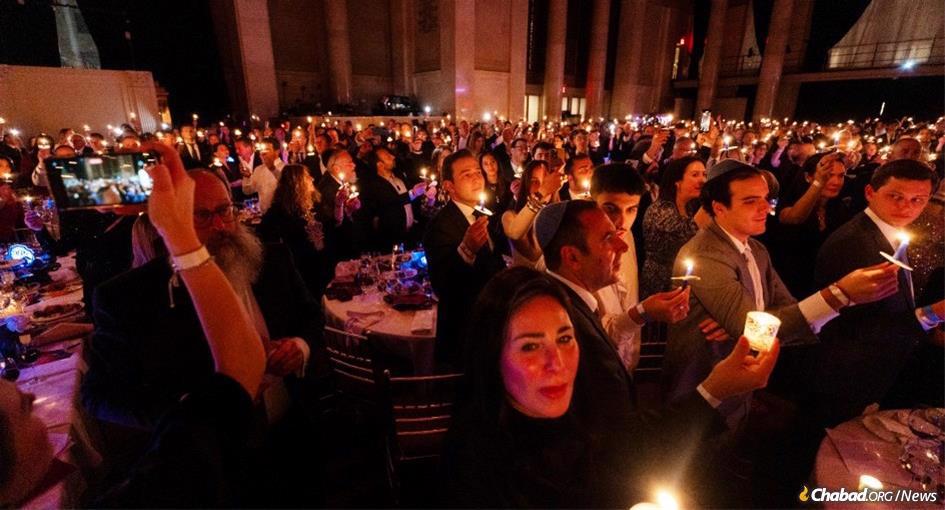
For the 1,500 guests who attended Belev Echad’s fundraising gala in Manhattan on Nov. 20, the evening was far more than an opportunity to raise $4.3 million for wounded Israeli soldiers. It was their first opportunity to personally connect with young heroes of the Israel Defense Forces who were seriously injured protecting the people of Israel during the terrorist attack on Oct. 7, when more than 1,200 were killed, thousands injured, and 240 taken hostage.
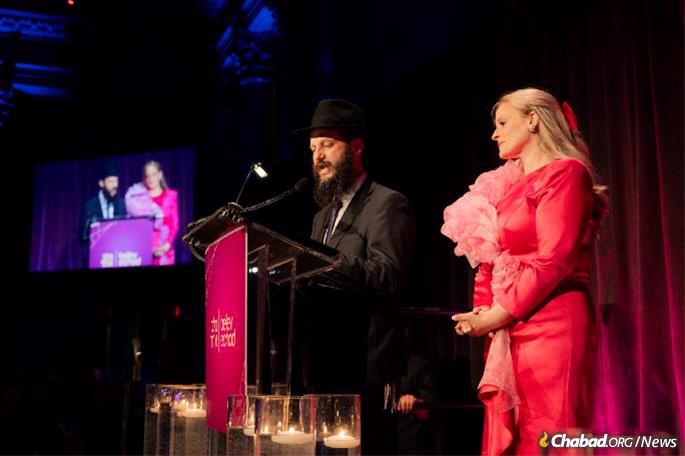
Belev Echad (meaning “With One Heart”) is a nonprofit global organization that provides support to wounded IDF veterans, including medical treatment, rehabilitation and a second chance at life. The dinner was the largest attendance ever, said Rabbi Uriel Vigler, who with his wife, Shevy, founded the organization in 2009, and also directs the Chabad Israel Center of the Upper East Side.
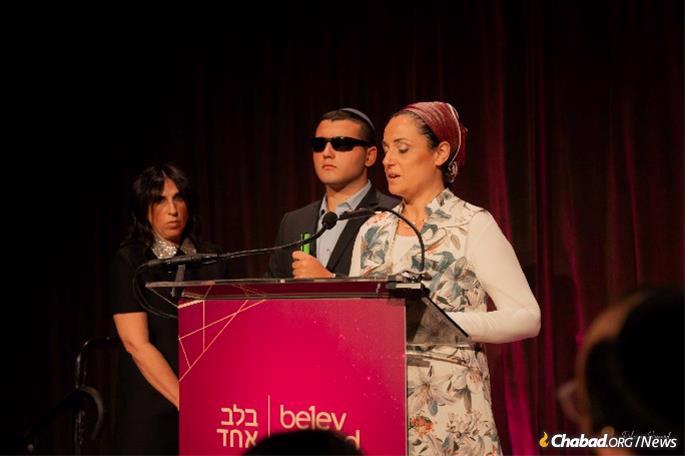
Four soldiers injured in the current war were flown to New York with their mothers to share their stories with the audience. In addition, two Israeli soldiers who were wounded during the Oct. 7 attack and are in New York for treatment attended the event.
Haifa native Yarden Hamo, 21, told the story of his near-fatal injury that occurred on Simchat Torah morning around 6:30 a.m. He served in the Golani Brigade’s 13th Battalion, stationed at the Gaza border.
“An alarm sounded, and we were unaware of the situation outside. We hopped on our armored vehicle ready for whatever would come as we sped along,” Hamo said in Hebrew, as his words were translated on a large screen for the audience.
“As we headed to the infiltration site, we started hearing heavy gunfire from a Kalashnikov rifle, and one of the terrorists attempted to open the back door of our vehicle. We maneuvered swiftly, neutralizing the terrorists while driving backward.
“Another terrorist began running toward Kibbutz Nir Am,” he continued. “Determined, we pursued him in our vehicle. But before we could reach him, we were struck by a rocket-propelled grenade fire from above, and the situation intensified.
“A motorcycle suddenly appeared carrying two armed terrorists. I opened fire at them and neutralized the terrorists. My comrade sustained injuries to the shoulder and the hand.”
‘An Unimaginable Scene’
He continued, saying “we pressed on and pursued the second terrorist. That’s when an unimaginable scene unfolded. Ahead of us stood approximately 40 terrorists in two vans. We advanced, trying to hit them, only to be struck by an explosion that rendered our vehicle inoperable.
“They started shooting at us with relentless gunfire. We fired back.
“Amidst the chaos, my friend sitting beside me leaned out of the vehicle to aim and was tragically struck in the eye by a bullet and collapsed inside.
“Before we could understand what was happening, a grenade was thrown inside the armored vehicle. In a selfless act a comrade shouted that he was sorry and jumped on it. He sacrificed his life to save ours.
“I continued to shoot and fight back though. This time I said the Shema for Hashem’s protection. Peeking out of the armored vehicle, I saw a terrorist aiming at me. I shot and killed him.
“I go back inside the vehicle. Another grenade was hurled at us. I saw the grenade on the ground between my legs and kicked it away from us. The explosion sent shrapnel causing severe injuries across my legs, hands, face and back.
“I was wounded. I had another wounded soldier in the armored vehicle, as well as a dead friend. I hastily tore my shirt to fashion a tourniquet to staunch the bleeding of my comrade.
“Another grenade followed. I couldn’t see anything. I couldn’t breathe. I saw death, but I couldn’t give up.
“We waited for someone to help us during those intense moments of uncertainty. I made a decision to record a farewell message to my beloved family and friends. Thankfully, the farewell video was not necessary as we were rescued after an hour-and-a-half of nonstop RPG missiles.
“Prompt medical attention was provided, and against the odds, I survived. I have reclaimed my life, and for that, I’m immensely grateful.”
‘Hearts and Minds in Israel’
Attendee Vanessa Chalme says the guests at the gala were deeply moved by the soldiers.
“Sometimes, we who live in America can feel like we’re a little far from Israel,” Chalme told Chabad.org. “I think for some people at the gala, this was a wake-up call, and it helped people realize how great the need is there.”
“There is one thing that always comes up when you speak to these soldiers is that these are modern-day heroes. They feel like, ‘I used to be a soldier, and now I’m just somebody who is injured.’ But for us, these people are part of the story of Israel. They are heroes, and most importantly, they are teaching us faith and resilience. They give us hope that no matter what comes our way, if they can do it, we owe it to them that we have to do it, too.”
Uplifting and encouraging wounded soldiers follows the longstanding example and practice of the Rebbe—Rabbi Menachem M. Schneerson, of righteous memory. In 1976, for example, the World Paralympic Games were held in Toronto, and a large Israeli delegation attended, most of them IDF soldiers wounded in battle. During their trip, they flew to New York to meet the Rebbe, who received them with great honor.
In a special Hebrew-language address to the group, the Rebbe noted that when someone has a physical weakness or lacking, it is no reason to be dejected; rather, it is proof-positive that the Creator has endowed him or her with special spiritual powers that enable him to overcome and succeed where the ordinary person cannot.
“The term ‘handicapped’ should not be used for anyone,” the Rebbe told the soldiers. “To the contrary, he is someone special and exceptional by the Creator, with special powers above and beyond the capacity of an ordinary individual. They should therefore be called what they truly are: ‘exceptional.’ ”
Audience Inspired by Soldiers’ Dedication
At the gala, the 1,500 people lit and lifted candles in the dark room and recording artist Yaakov Shwekey sang. “In every generation they try to kill us, they try to murder us, but G‑d saves us from their hand.”
Vigler said of Shwekey’s song: “It was a very, very powerful awesome moment.”
Sandy Dweck was an honoree at the gala who was recognized for her Shabbat hospitality for the delegations of soldiers that come to New York annually as guests of Belev Echad.
“The level of support that there was for the gala this year was tremendous,” Dweck said. “The people wanted to be there, wanted to show up, support Israel and the soldiers. It was definitely more somber, realizing where we are now.”
“Everybody’s hearts and minds are in Israel,” agreed Vigler, pointing to the large turnout. “Our heart is in the East.”

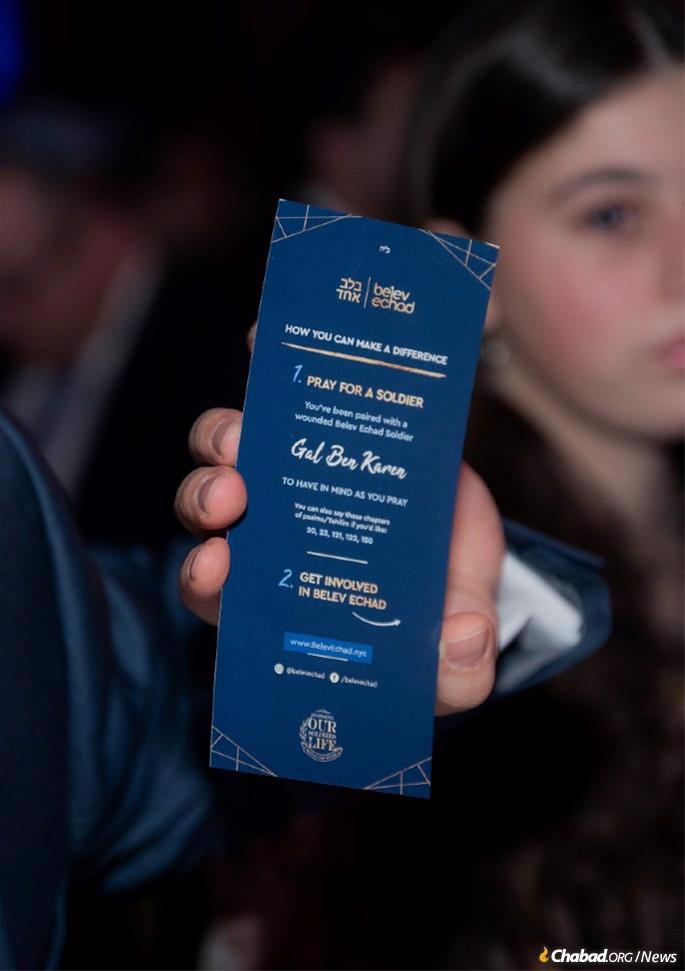
Guests received bookmarks with the name of a wounded soldier to pray for. About 2,000 have been injured in the current war, Vigler said.
“We asked every attendee to take the bookmark home and have in mind that soldier with every mitzvah that we do. That’s your soldier that you need to focus all your efforts on to heal him or her.”
Belev Echad operates a treatment facility in Israel that provides therapies and fellowship for 1,100 wounded soldiers.
“Camaraderie is essential to the healing process,” says Vigler. “When a soldier looks into the eyes of a fellow soldier and they have so much trauma and so much pain, they understand each other.”
Vigler envisions a world where the organization is shut down, “where Moshiach will come, and there won’t be any more wounded soldiers and there won’t be a need for Belev Echad. But until that day happens, we will be there for every single soldier to give him or her whatever they need.”



my brother is a solider in isreal and I am his sister and I have a dream but never came true I am asking for you guys support to surprise me with Yaakov shwekey to make my dream come true that I can have a happy life and that Yaakov can pick up my spirit