


In late 1979 the Embassy of the United States in Tehran was overrun by Iranian student terrorists and 50 Americans taken hostage. The embassy attack was a brazen affront to U.S. prestige worldwide, and President Jimmy Carter came under unrelenting pressure to secure the safe return of the hostages. In the midst of the ever-worsening Iran Hostage Crisis, the beleaguered president stepped out of the White House one mid-December evening to dedicate the first-ever lighting of the National Chanukah Menorah.
It was the fourth night of Chanukah, Dec. 17, 1979. With advisor Stuart Eizenstat and administration staff at his side, the president left the White House on foot, crossing the street to enter Lafayette Park, where the giant menorah had been erected. There he was greeted by Chabad-Lubavitch Rabbi Abraham Shemtov, who escorted him to the podium. Carter was honored with the lighting of the shamash—the candle from which the others are kindled—after which Eizenstat, his two young sons, and incoming Secretary of Commerce Philip Klutznick lit the candles on the menorah. After a few words by Shemtov, the rabbi introduced the president to share his thoughts with the assembled crowd.
“[T]he season of Chanukah commemorates the victory of religious freedom,” President Carter said as he stood next to the menorah. “At the commencement of the celebration of this annual event, this season of thanksgiving and closeness to G‑d, there was a miracle within which the candle which was supposed to only burn a short time burned for eight days and nights.”
With the 52 American hostages on his mind, Carter saw more than just a history lesson in the message of Chanukah. “This miracle,” he said, “showed that G‑d meets our needs. If we depend on Him, He will meet our needs.”
The White House had prepared short remarks for the president, but he chose to discard them and speak extemporaneously from the heart.
“This season commemorates the perpetuation of age-old dreams and the hunger of men and women down through the ages to maintain a spirit committed to life under the most difficult circumstances, the most difficult persecutions, the most difficult dangers, and the most difficult suffering,” Carter continued. “It also commemorates humankind’s commitment to be free. These commitments to live and to be free are ever present these days in the minds and hearts of all Americans, because we know that 50 of our fellow human beings, our fellow citizens, are not free and they want to live. We pray that this will prevail, this desire to be free and to maintain life.”
Echoing a Chassidic teaching, the president noted that the shamash candle’s light does not diminish when it shares its flame with others. “It shows that when we give life and love to others, the life and love in our own hearts is not diminished. As a matter of fact, it grows the more we share it. So, tonight we pray that our closeness to G‑d, our memory of these fine commitments of human beings down through the ages will strengthen our desires to share our life and our love … for men and women throughout the world who don't always have freedom and whose lives might be in danger.”
That fourth light of Chanukah, Jimmy Carter, who died at age 100 on Dec. 29, 2024, became the first American president in history to publicly light a Chanukah menorah, kicking off an annual Washington, D.C., tradition that has helped launch the Jewish holiday into the public sphere. Chanukah is celebrated according to the Jewish calendar, and Carter’s passing occurred on the fourth light of the holiday—exactly 45 years to the day since he kindled the menorah.
The National Menorah was the brainchild of Shemtov, a Chabad emissary in Philadelphia who also chairs American Friends of Lubavitch (Chabad) in Washington, D.C, serving for more than half a century as representative of the Rebbe, Rabbi Menachem M. Schneerson, of righteous memory, to the nation’s capital. Just a few years earlier, in the winter of 1973, the Rebbe launched a Chanukah awareness campaign, urging increased private observations and public displays of the eight-day holiday.
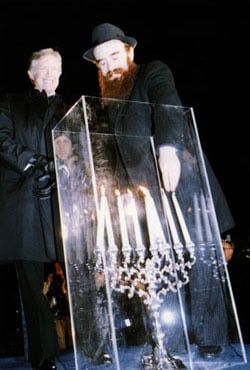
When he initiated the Chanukah campaign, the Rebbe spoke of the need to bring the light of the menorah to the streets, not only as a reminder that Jews in America are free of persecution and deserve to enjoy their rights as a minority, but as a universal message of freedom and liberty for all. On Chanukah 1974—exactly 50 years ago—Shemtov erected the first-ever public menorah in Independence Mall in Philadelphia, followed quickly by giant Chabad menorahs in San Francisco and New York City. The National Menorah was perhaps the most prominent of them all.
“I … take this opportunity of expressing to you my genuine gratification at your personal participation in the ceremony of lighting the Chanukah Candelabra in front of the White House,” the Rebbe wrote to Carter several weeks after his dedication of the National Menorah. “The symbol of light is universal for all people on earth, Jews and non-Jews. The intrinsic power of light, in that even a small light dispels a lot of darkness, is surely a source of inspiration to all men of good will with its eternal message of the eventual triumph of all that is good and bright in human life.”
Eizenstat, the president’s domestic affairs chief, had played a key role in setting up the National Menorah, and the Rebbe wrote separately thanking him, noting in particular the participation of Eizenstat’s wife and young sons—who recited the blessings on the menorah—in the ceremony. (The renowned opera tenor Jan Peerce sang Maoz Tzur.)
But it was the president himself, Carter, who inaugurated the new national tradition.
“I felt it was important for our country to practice its commitment to religious pluralism by lighting the menorah on U.S. Park Service land,” Carter told the Washington Post in 2020. “I hoped this would help elevate this Jewish holiday into one all Americans would recognize, and I am grateful this annual event has grown much larger over time.”
Indeed, every administration has participated in the National Menorah celebration since, and the annual event—which moved from Lafayette Park to the Ellipse in 1987—draws thousands of participants, and the menorah is seen by millions. Today, the Chabad movement erects some 15,000 giant public menorahs around the world.
Conflicting Legacy
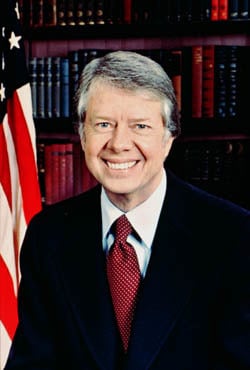
President James Earl (“Jimmy”) Carter was born on Oct. 1, 1924, in Plains, Georgia, where he lived for most of his life. A Navy veteran and activist in the civil-rights movement, he began his political career in 1963 as a Georgia state senator before being elected governor of Georgia in 1970. In 1976, he defeated incumbent President Gerald Ford and served one term as president until his defeat by Ronald Reagan in the 1980 election.
Carter’s legacy is not a simple one. His position towards Israel during his presidency severely hampered its ability to defend itself, and his post-presidential Middle East activism led many to question Carter’s affinity for the Jewish people in the first place. Nevertheless, as the Rebbe highlighted in particular in the aftermath of, and in reference to, Carter’s 1980 loss, “Torah bids us to be grateful [and] to acknowledge those good things which were done.”
Speaking on Jan. 15, 1981, during the last few days of Carter’s presidency, the Rebbe explained that “in a democracy such as the U.S.A., an orderly transference of government is effected through the electoral process,” with the people’s choices at the ballot box ensuring a peaceful transition from one administration to the next. “Yet a disturbing trend has been evident in past elections. When the previous incumbent in the Oval office is the defeated candidate, his defeat has triggered a less than noble response; it is seized upon by some as an opportunity to rejoice in his discomfiture. Stripped as he now is of power, such critics fear no retaliation on his part; nor can they now expect to gain any favors. And so they indulge in the ignoble pastime of rubbing salt into the wound.”
This, the Rebbe explained, was not the way of Torah, which views ungratefulness as a terrible trait.
Indeed, the Rebbe’s emphasis on this fundamental educational point—gratefulness—tied directly into his broader message for American society: The careful attention that must be paid to fostering a moral and ethical education.
The Nature of Education
The Rebbe was a staunch supporter of the non-denominational Regents prayer recited for years in New York public schools, warning against the negative impact the U.S. Supreme Court’s 1962 ban on it would have on the next generation. Later, the Rebbe would strongly advocate for a Moment of Silence in public schools as a way to allow children the opportunity to ground their school day—and the knowledge they gained—in accountability to the Creator of the universe.
“Education, in general, should not be limited to the acquisition of knowledge and preparation for a career, or, in common parlance, ‘to make a better living,’” the Rebbe explained. “We must think in terms of a ‘better living’ not only for the individual, but also for the society as a whole. The educational system must, therefore, pay more attention, indeed the main attention, to the building of character, with emphasis on moral and ethical values.”
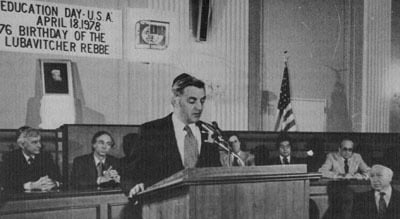
In recognition of the Rebbe’s devotion to the cause of education, Congress passed a resolution designating April 18, 1978—corresponding to 11th of Nissan, the anniversary of the Rebbe’s birth—as Education Day U.S.A, with Carter subsequently signing it into law. This was the beginning of Education Day, with every president since designating the anniversary of the Rebbe’s birth as a day dedicated to educational awareness.

The Rebbe saw in Education Day something crucial for the United States, and through it the world. “While the timing of this action was conceived as a tribute to our movement, which sees in education the cornerstone not only of Jewish life, but of humanity at large, and has been dedicated to this vital cause ever since its inception more than two hundred years ago—it is a fitting and timely tribute to the cause of education in general, focusing attention on what is surely one of the Nation's top priorities,” the Rebbe said at the 11 Nissan gathering marking his birthday that year.
“It is fitting indeed that the U.S.A. has shown, through a forceful example to the world, that it places education among its foremost priorities. It is also to be hoped that ‘Education Day’ will become a permanent institution, especially since, by reason of the pervasive nature of education, it would lend further significance to other ‘Days’ such as Father’s Day and Mother’s Day and similar institutions which have become part of American life.
“The proclamation of ‘Education Day, USA’ is of extraordinary significance in impressing upon citizens the importance of education, both in their own lives as well as, and even more so, for the young generation in the formative years—particularly in the present day and age.”
A full-page ad with excerpts from the Rebbe’s address later appeared in The Washington Post. “I read with great interest … your response to the resolution passed by Congress designating April 18, ‘Education Day - U.S.A.,’” Carter wrote to the Rebbe. “I admire the thoughts which you expressed—and am grateful for your support and prayers. I am delighted that ‘Education Day - U.S.A.’ falls on your birthday … .”
“Your personal interest in the cause of Education, coupled with the influence of your exalted position,” the Rebbe responded, “goes a long way in promoting the vital importance of Education in general, and is a source of further encouragement to the dedicated activities of the movement which I am privileged to head.”
Since Carter’s establishment of Education Day in 1978, the idea of one day dedicated to thinking about the education of youth in the United States, focusing particularly on the higher meaning of education, has resonated across party lines. It is indeed a rare unifying space in an often fractured political and societal arena.
Around the same time, Carter set into motion his campaign promise to create a cabinet-level Department of Education, an arduous process requiring Congressional approval. In February 1979, the Rebbe wrote a letter of blessing and encouragement to the president, expressing his “ardent hope that not only will the proposal be expeditiously acted upon by Congress, but that governments of other nations will emulate your example. For, although some countries already have a separate Department of Education, there are those that have not, and all those where education has still to be placed as a top national priority.
“I am, of course, referring to education in a broader and deeper sense,” the Rebbe continued, “not merely as a process of imparting knowledge and training for a ‘better living,’ but for a ‘better life,’ with due emphasis on character building and moral and ethical values.”
While mindful that a Cabinet-level Department of Education must be “subject to legislative safeguards to ensure that the traditional primacy of States and localities in education [not] be jeopardized,” the Rebbe argued such a well-funded department would “pointedly underscore [education’s] proper place among the Nation’s highest priorities.”
Active in Carter’s effort to create the Federal Department of Education was Vice President Walter Mondale, to whom the Rebbe wrote on Feb. 26, 1979: “The Administration’s resolve to restructure the Federal education role — long overdue — would be well served if it were coupled with greater emphasis on the objective of improving the quality of education in terms of moral and ethical values and character building that should be reflected in the actual everyday life of our young and growing generation.”
Security at Home and Abroad
That the Jewish people have not only the right, but the moral duty, to protect themselves from outside threats was a longstanding and deeply-held opinion of the Rebbe. The Rebbe would often cite the Code of Jewish Law (Orach Chaim 329:6), which states that Jews may desecrate Shabbat to defend themselves if their lives are threatened by neighbors. Even more so, the Code of Jewish Law continues, “In a town that is near the border, even if [the non-Jews] only seek to come for matters concerning hay and straw, the Shabbat may be desecrated because of them, lest they capture the town, and from there, the [entire] land will be easier for them to conquer.”
Indeed, it was this outlook that drove the Rebbe’s commitment to staying put and bolstering the Jewish neighborhood of Crown Heights, Brooklyn, in an era when many other Jews had been forced to flee urban Jewish neighborhoods throughout the U.S. The Rebbe saw Crown Heights as a test case; if its Jews were forced out of their homes and stores, communities throughout Brooklyn, the U.S. and the world, would be placed at grave risk. Not only would this be a problem for Jews, but the very concept of the City would be imperiled.
The Rebbe worked quietly for years to stabilize the Crown Heights Jewish community, and began publicly addressing the subject in 1969, maintaining his stance that the Jews remain there through New York City’s most difficult years. This was something that Carter knew about and appreciated. “As one of the principal architects of the President’s urban policy, I am familiar with what the Rebbe has done in stabilizing your community,” Eizenstat shared at a Crown Heights event in January of 1980, speaking in the president’s name. “You did not run. You have served as a shining example for urban America throughout the United States. You have shown that our cities can and will survive.”
Naturally, the Rebbe believed this basic principle of self-defense applied in the Land of Israel as well. The Land of Israel was so small, the Rebbe explained, that it was to be considered in its entirety a “border town,” and any compromises to its territorial integrity placed the lives of millions of Jews at stake. Carter unfortunately disagreed, to disastrous results.
From the start of his presidency, Carter insisted that Israel relinquish all or most of the land that it had won in the 1967 Six-Day War. The Rebbe, meanwhile, maintained that without fundamental changes in the mindset of Israel’s enemies, dangerous compromises of strategically vital land would only lead to further demands, risking more and more Jewish and non-Jewish lives with every concession.
The issue was put to the test soon after the election of Menachem Begin as prime minister of Israel in 1977, when Begin traveled to the United States for his first meeting with Carter. On his way to Washington, D.C., the prime minister stopped in Brooklyn, N.Y., to consult with the Rebbe.

“I have come tonight to our great master and teacher, the Rabbi, to ask from him his blessings before I go to Washington to meet President Carter … ,” Begin told the gaggle of press waiting for him outside of the Rebbe’s office and synagogue at 770 Eastern Parkway in Brooklyn. “Rabbi Schneerson is a great man in Israel. All of us respect him; all of us accept his judgment. He is a great lover of the House of Israel. He has shown his deep sentiment and love for our children. His blessings are very important to me. I hope they will strengthen me and this very important mission I am going to fulfill during the meetings with President Carter, the president of the United States.”
During that first meeting, Begin held strong to his convictions that Israel could not compromise on its own security just for a pat on the back from the United States and the international community. When the talks with Carter concluded, Begin sent an aide, Ambassador Yehuda Avner, to New York to provide a summary to the Rebbe. As Avner would later recall, the Rebbe was impressed by Begin’s initial performance, dictating a message to Begin congratulating him for “safeguarding the integrity of the Land of Israel while avoiding a confrontation with the United States. This is true Jewish statesmanship: forthright, bold, without pretense or apology,” the Rebbe said. “Continue to be strong and of good energy.”
Unfortunately, and to his everlasting regret, Begin later succumbed to the intense pressure he faced during the ill-fated Camp David Accords and made the devastating mistake of giving away the Sinai Peninsula, which Israel had captured in defensive measures in 1967, to the Egyptians. “Poor Menachem, he has his problems … ,” Egypt’s President Anwar Sadat would gloat in 1980. “After all, I got back 90 percent of the Sinai and the Alma oil fields and what has Menachem got? A piece of paper.”
Meanwhile, the Rebbe continued to maintain that Israel was making a mistake it would not, and could not, easily overcome.
“[Of] late, our title to [the Land of Israel] has been challenged by the very nations who, by force of arms, repeatedly sought to rob us of our everlasting possession,” the Rebbe wrote in 1980. “Sadder still, there appeared some Jewish leaders who, for the sake of peace, or rather the illusion of peace—and frightened by threats of further violence in the midst of a hostile and callous world—were prepared to and actually did surrender portions of our land, in the ill-conceived belief that our enemies would thereby be appeased. Moreover, contrary to all experience and common sense, which have demonstrated again and again that every act of appeasement and concession only invites stronger pressures to yield to even more avaricious demands, there are still those among our own people who persist in following this dismal course. The so-called Camp David Accords are only the culmination of the first phase of this ill-fated and self-defeating policy.”
Nevertheless, when Carter’s time in office came to an end, the Rebbe emphasized the good the president had accomplished.
“The above acknowledgment is in no way to be construed as a retraction from my previous stand concerning the Camp David accords,” said the Rebbe. “I reiterate as strongly as possible that it was, and remains, a disaster and peril for Jews and for the rest of the world…
“[But] notwithstanding any errors made, we are enjoined by Torah to express gratitude where credit is due. This is a man who safeguarded the well-being of millions of Americans, and to him we duly express our gratitude.”



And as for Education Day, what to do now when the academy itself is rife with Jew-hatred?