

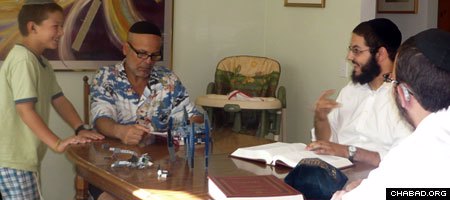
Helping Jews the world over feel connected as opposed to isolated has long been the mission of Chabad-Lubavitch emissaries and the corps of rabbinical students who annually fan out to disparate communities across the globe.
And as one such project in Rochester, N.Y., a university town that is no stranger to established Jewish infrastructure, demonstrates, the isolation needn’t be geographical.
This week, Joshua Soudakoff and Isser Lubecki, both 19, set off from Toronto for Rochester in order to address the special needs of deaf members of the Jewish community. Uniquely qualified for their mission – the Los Angeles-born Soudakoff and the Paris-born Lubecki are both deaf and attended Yeshivas Nefesh Dovid, a school geared towards the deaf – the students have been using a combination of American Sign Language and speech to provide programs and learning opportunities to one of the world’s largest deaf populations.
Rabbi Asher Yaras, director of the Chabad House Jewish Student Center serving Rochester-area colleges, attributed the city’s high concentration of deaf individuals to the Rochester Institute of Technology-affiliated National Technical Institute of the Deaf, one of the nation’s largest schools for the deaf. He estimated that 50 Jewish families in Rochester have at least one deaf member.
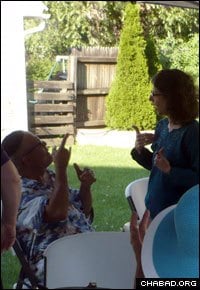
Soudakoff and Lubecki travelled to Rochester as part of the popularly-known “Roving Rabbis” project, the Rabbinical Summer Visitation Program run by the Chabad-Lubavitch educational arm. Their first formal event of the week was a meet-and-greet barbeque hosted by local deaf resident Dr. Carolyn Stern Spanjer and her husband Al, while their schedule has them running a weekend Shabbaton, a challah-baking session and children’s activities.
“We’re offering people the chance to meet with the students to learn something they’ve always wanted to learn but couldn’t because of the language barrier,” said Yaras. “It could be anything from the Jewish view on heart transplants to the weekly Torah portion.”
Diana Pryntz, one of 20 people who attended the barbeque, heard about the students’ visit from her hearing husband, who provided sign-language interpretation at a recent event hosted by Yaras’ center. Pryntz, a former NTID student, helped spread the word through a mailing list she coordinates for the Jewish deaf community.
“It was fun to see everyone and to meet the two rabbinical students,” she said.
Conquering Challenges
Soudakoff and Lubecki, who are part of a veritable army of students who are providing underserved communities with kosher food, information packets and religious items, said that the deaf community faces its own brand of challenges.
“I think that it’s mainly in the area of communication where the challenges arise,” said Lubecki. “For example, when a person asks for my name and struggles to get it or a person asks me for the location of a street, and can’t understand what I’m saying.”
Soudakoff agreed that trying to be understood by those in the “hearing” world can be frustrating.
“Some people just don’t have the patience to try to understand what I’m saying, and they just nod along to whatever I say,” he said. “Sometimes, people don’t understand that deafness is a physical condition, not a mental issue. Being deaf has nothing to do with our intelligence, but there are those who assume that we need help in that area, and they show that in the way they communicate with us.”
There is also the isolation from cultural expression.
“I think that one of the toughest things about being deaf is that you’re not always able to take advantage of everything that there is out there,” said Soudakoff. “We miss out on all the Jewish music that comes out.
“Basically, much of the Jewish world is based on the ability to hear,” he added. “Praying in a minyan, reading from the Torah, and listening to a class all emphasize hearing. There are also several commandments that depend on sound, such as listening to the shofar, or listening to the reading of the Scroll of Esther. It’s often challenging to make the best of what we are able to participate in.”
Rabbi Nechemia Vogel, director of Chabad of Rochester, said he hopes to have Soudakoff and Lubecki return to continue their outreach to the deaf Jewish community.
“We recognized the need and thought the best way to do it was to have someone familiar with the community,” said Vogel. “The feedback so far is that this is appreciated. We really want to reach every single Jew.”
Rabbi Moshe Kotlarsky, vice chairman of Merkos L’Inyonei Chinuch, the educational arm of Chabad-Lubavitch, echoed that point.
“Every summer, teams of Chabad-Lubavitch rabbinical students fan out across the globe to strengthen Jewish communities and individual Jews wherever they may be,” he said. “Characteristic of their mission is the charge to meet people where they are and to assist them with their particular spiritual needs. Who better to address the needs of this particular community than two young Talmudic scholars intimately familiar with the challenges it faces?
“From the reports that are reaching our office,” he continued, “they’ve been doing amazing work.”
“Every person has his or her own challenges,” said Soudakoff. “In a way, it’s fortunate that our challenge is obvious enough to us that we never have to waste our time figuring out what it is. Instead, we just figure out how to deal with it. We build our own communities, complete with a different language, and we create a new reality that is more comfortable for deaf people.
“I hope that Isser and I will be able to break through this created reality and contribute some Judaism,” he added. “That is our mission in Rochester.”

"What took Chabad so long" Keep in mind that deaf jews may don't have money to fly to NCSY conventions, shabbatons, (I couldn't come for years cuz of $$).
It is not Chabad's fault, right now, these nice sweetest gentlemen whom i had pleasure meeting in Toronto, are available to travel between school session.. we hope they'd do more in near future.