


South Dakota, with a very small Jewish population scattered throughout the state’s vast expanses of windswept prairies, has long held the dubious distinction of being the only state in America without a rabbi.
That will soon change, when Rabbi Mendel and Mussie Alperowitz move from Brooklyn, N.Y., to Sioux Falls—the state’s largest city—to direct a Chabad-Lubavitch center that will cater to a community dating back to the days of the Wild West.
The young couple’s arrival is being met with special attention as North American Jewry marks 75 years since the Rebbe—Rabbi Menachem M. Schneerson, of righteous memory—and his wife—the Rebbetzin Chaya Mushka, of righteous memory—arrived on U.S. shores from war-torn Europe in 1941.

There will now be a permanent Chabad presence in all 50 states in America, as well as Puerto Rico and the U.S. Virgin Islands.
The appointment was made by regional director Rabbi Moshe Feller of Upper Midwest Merkos Lubavitch, and was announced to an emotionally charged gathering of 5,600 Chabad-Lubavitch rabbis and lay leaders in New York at the gala banquet of the International Conference of Chabad-Lubavitch Emissaries (Kinus Hashluchim) by Rabbi Moshe Kotlarsky, vice chairman of Merkos L’Inyonei Chinuch, the educational arm of the Chabad-Lubavitch movement, and director of the Kinus.
“Tonight’s devar Torah will be a milestone,” noted Kotlarsky. “A young couple is moving out to a location with a small Jewish population. Tonight, I invite the shaliach who is going out to the 50th state of the Union. Seventy-five years after the Rebbe arrived on these shores, every state of the Union will have a permanent representative. Join me as we welcome the shaliach and shluchah to Sioux Falls, South Dakota.”

Alperowitz recalled a blessing to “fort gezunterheit—travel in good health”—that he received from the Rebbe as a child preparing to return home to England together with his parents, sharing with the crowd how those words are fortifying him today.
“Those are the words I carry in my heart, as my wife, our two daughters and I ready ourselves to move to the Rushmore State—the final state without a permanent Chabad shaliach,” said Alperowitz. “Like the faces of some of our country’s greatest leaders etched into that faceless mountain, we hope to carve the image of our forefathers in the blank earth.”
The emissaries in the cavernous pier-turned-ballroom on Brooklyn’s Pier 8 responded to news of the appointment with resounding applause. They hailed from 90 countries, each inspired by the Rebbe’s decades-long campaign to bolster and revitalize Judaism in every part of the world.

A Completion in ‘A Country of Kindness’
That effort began immediately upon the Rebbe’s arrival on American shores after narrowly escaping the Nazi death machine, when his father-in-law and predecessor—the sixth Rebbe, Rabbi Yosef Yitzchak Schneersohn, of righteous memory—appointed him to head the movement’s work to spread Judaism and its message of universal morality throughout his adopted country and beyond.
The Rebbe would often refer to the United States as “a country of kindness” and expressed his gratitude and appreciation for the nation that became the welcoming haven for the Lubavitch movement. Poetically, the final state to welcome a permanent emissary couple is home to Mount Rushmore, the iconic symbol of American history and presidential leadership, which was completed only months after the Rebbe’s arrival in New York and the start of his outreach work there.
The Chabad-Lubavitch emissaries’ move to South Dakota is being seen as a boon for the state, its Jewish residents, and significantly beyond.
In the latter half of the 19th century, following the construction of transcontinental railroads and the discovery of gold in the Black Hills, Jewish merchants flocked to the area (then the southern part of Dakota Territory). They established businesses stretching from Sioux Falls in the east to the Black Hills in the west and were part of a prosperous community when the territory became a state in 1889.
As with many smaller American Jewish communities, the mid-20th century saw younger Jews leave for larger metropolitan areas, with few returning back home.
“We have almost no grandparents in this community whose grandchildren live here, too,” says Stephen Rosenthal, a Texas native who has lived in South Dakota since 1973 and serves as the state chair of AIPAC. “Most of the Jewish people here now were not born here, and many of the grown children choose not to stay. Others come and replace them.”

A Decades-Old Relationship
One constant for South Dakota Jewry, however, throughout the years has been Chabad-Lubavitch. Shortly after the Rebbe arrived on U.S. shores, he began dispatching traveling rabbinical students to isolated communities around the globe, laden with heavy suitcases of Torah literature and Judaica materials, boundless energy and vibrant Jewish knowledge. From the outset, there were visitors to Rushmore State.
The young rabbis combing the state to meet with individual Jews scattered through an area of 77,000 square miles were often the Jewish lifeline for the small-town merchants and farmers who were the descendants of 19th century immigrants (Since the mid-1980s, Rabbi Mendel Katzman, Chabad-Lubavitch emissary to nearby Omaha, Neb., has also made periodic visits to assist the community.)
Rosenthal notes that the Roving Rabbis’ visits picked up in frequency in recent years. “It used to be summer, then [also] Chanukah and then [also] Purim,” he reports. “It became something we grew to expect and appreciate.”
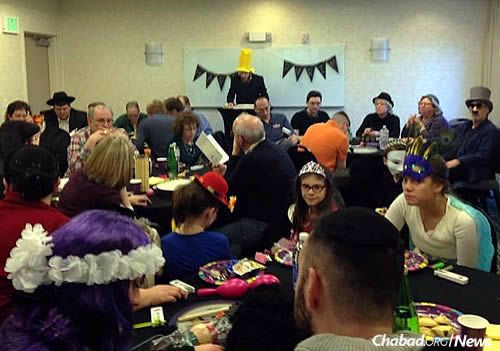
The Alperowitzes visited South Dakota for the Purim holiday, in March of this year, where they held two events: a community celebration in Sioux Falls that drew 45 attendees and another program for a dozen Jewish students at South Dakota State University in Brookings.

‘An Instant Communication’
“We did minimal advertising before Purim,” says the rabbi, whose parents are long-serving Chabad emissaries to Bournemouth in southern England where he grew up, “spreading the word through the people who had been in contact with the ‘Roving Rabbis.’ ”
He reports that many of the people who came to the celebration didn’t know each other. “People kept saying, ‘It’s amazing to see that there are so many other Jews in town. We had had no idea they were here!’ ”
The couple remained for another five days, when they met dozens of Jewish people in homes, offices and public places.
“We were so warmly received,” reports Mussie Alperowitz. “It was inspiring for us to see people who really gave their all to maintain communal infrastructure for decades. We felt an instant connection with the people we met, and people asked us if we would consider opening up a permanent center.”
Although it has been widely accepted that fewer than 400 Jewish people reside in the entire state, Rabbi Alperowitz estimates that it may actually be home to as many as 1,000 Jews. He also believes that the Jewish population may have been bolstered in recent years by a strong economy and the growing financial and healthcare industries.

After two more visits (most recently during the holiday of Sukkot), and with the encouragement of Sioux Falls Mayor Mike Huether, the Alperowitzes—along with their infant daughters, Rochel and Shaina—decided to relocate there for good.
“Even though we will be living in Sioux Falls,” says the rabbi, “we will be traveling regularly to serve other Jewish communities and individuals wherever they may be, including the incarcerated.”
Rosenthal is excited about the educational programs the couple will offer. “We look forward to them living here,” he says, noting that it will be a significant change for a community that has not had a permanent rabbi in decades. “We will develop a new relationship with each other, and I am excited for that.”
His sentiment is mirrored by that of Dr. Richard Klein. “I do a lot of studying Torah on my own,” says the urologist originally from Cleveland, “so it will be wonderful to be able to study with a rabbi and increase my Jewish understanding.”
Recognizing that the local Jewish community is diverse in its level of Jewish observance, he says he believes that the Alperowitzes “have the wisdom to bridge the gap and help bind us all into a strong, unified community.”
To donate please visit www.southdakotajewish.com.





What a joy it will be for Sioux Falls and South Dakota to have Rabbi Mendel Alperowitz, his wife Mussie and their two young children in their midst.