

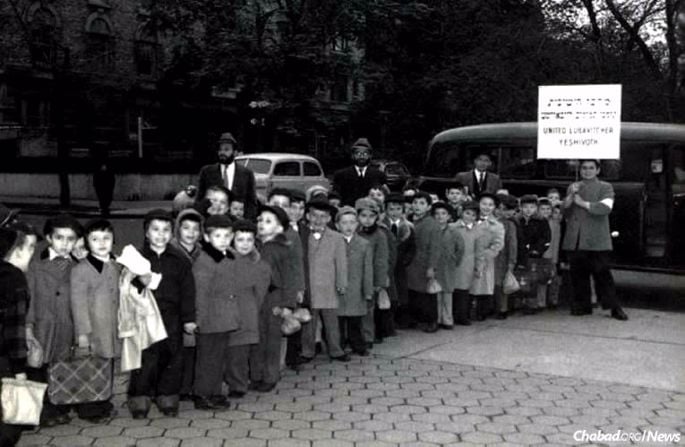
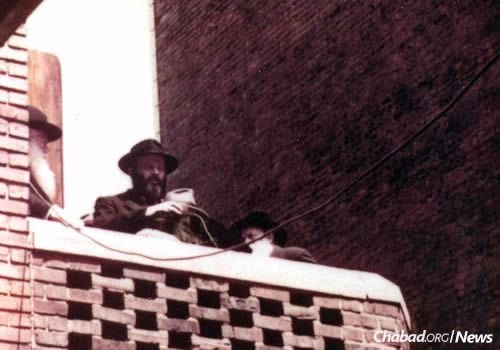
On May 3, 1953, Yosef Minkowitz, all of 5 years old, marched in the first Lag BaOmer children’s parade in New York City. He and another 200 or so students from Jewish schools started in the back courtyard of Chabad-Lubavitch headquarters at 770 Eastern Parkway in the Crown Heights neighborhood of Brooklyn—the courtyard that later became part of the now famous expanded synagogue. It was there that they heard from the Rebbe—Rabbi Menachem M. Schneerson, of righteous memory—who, standing on a small porch, spoke to the children with a passion Minkowitz recalls to this day.
The Rebbe told them the story of Rabbi Akiva, who at age 40 had not yet had a chance to learn Torah. Struggling with poverty and other challenges, it was doubtful that he would ever be able to manage it. What convinced him that he would succeed? It happened once that he saw water dripping on a rock. He saw that the years of constant dripping had caused the rock to erode.
“The rock is very hard, and the waters are soft, and every drop is so very small,” he observed. “Yet when the water falls day after day, week after week, month after month, they eventually split open the stone.”
How much more so, he reasoned, would Torah eventually enter his mind. And so he studied day in and day out for years. Eventually, he became the great Rabbi Akiva.
“This is a lesson for every student who is beginning to study Torah,” said the Rebbe to the children. “At times, the way looks long and hard, and you doubt if you will succeed and you wonder what the point is . . . For this we have the days of the Omer, which are connected with Rabbi Akiva, which settle all doubts, reminding every student that if he decides to study Torah with earnestness he is guaranteed success—not just in Torah learning but in all matters.”
The 1953 Lag BaOmer parade was the first of 12 parades that the Rebbe would attend during his leadership of the Chabad-Lubavitch movement. All but one were held on Sundays, a day when children from public schools would be able to attend alongside day-school students.
The proceedings at the parades were orchestrated by Rabbi Jacob J. Hecht, executive vice president of the National Committee for the Furtherance of Jewish Education. Founded by the sixth Rebbe—Rabbi Yosef Yitzchak Schneersohn, of righteous memory—and led by the Rebbe, the organization was charged with, among other things, the mandate to bring Judaism to Jewish children in New York City public schools. One of its central activities is the Released Time program, in which thousands of Jewish children receive a concentrated Jewish education during one hour per week set aside from their public-school day.
With his inimitable exuberance, Hecht would relay the Rebbe’s words (which were almost always in Yiddish) in plain English, ensuring that his public-school charges received the Rebbe’s message alongside their yeshivah-educated peers.
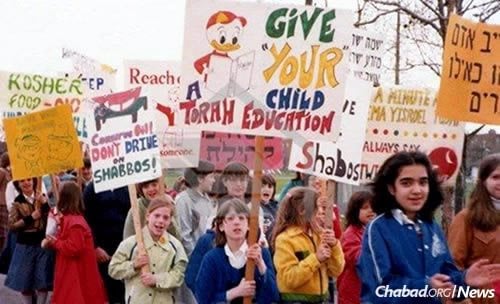
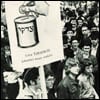
Though that first parade was relatively small in number, its impact was enormous. It started a tradition in the United States and around the globe. Within a few years, the parade in Brooklyn along Eastern Parkway would come to attract Jewish children from public schools and yeshivahs around the borough and the city. In the following decades, the parades would become a public affirmation of Jewish pride everywhere, with children holding and waving signs encouraging Jewish observance and good deeds.

For Yosef Minkowitz, who had arrived with his family to the United States just months earlier from Europe, that Lag BaOmer 5713, which fell on a Sunday, made an enduring impression.
“It was just a few short years after the Holocaust,” he tells Chabad.org. “Here we were, walking in the streets openly and proudly as Jews. It was very, very special. Most of us were little kids, but we walked with our heads held high.”
These days, Rabbi Minkowitz serves as head of school at Beth Rivkah Academy in Montreal. Some 64 years after that first parade in Brooklyn, he will be among thousands of Jews—from babies to baby-boomers—expected to participate in Montreal festivities this Sunday celebrating Lag BaOmer. It’s just one of many gatherings, large and small, to take place in Jewish communities worldwide.
The holiday begins after Shabbat on May 13 and lasts through the evening of Sunday, May 14.
Jews observe the period of the Omer—between the festivals of Passover and Shavuot—mourning over the death of the 24,000 students of Rabbi Akiva, who succumbed to a plague as a result of their lack of mutual respect. On Lag BaOmer, the 33rd day of the counting of the Omer, all mourning is suspended. The ensuing festivities are ecstatic: bonfires, live music, weddings and children’s parades.
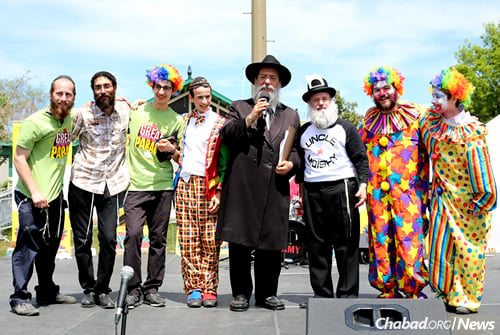
Like They Do in Meron . . .
Montreal was one of the first cities outside of Crown Heights to start its own Lag BaOmer parade, a communitywide event that draws students from multiple area day schools, and when it falls on Sundays, Jewish students from public schools near and far as well.
Minkowitz oversees an academic institution that has flourished over the years. When he first started working as principal of the girls’ school in 1974, about 150 students were enrolled; that number has grown to a current 500 young women. “We teach chai to chai,” he says, referring to both the Hebrew word for “life” and the number 18. “We have a curriculum for every Jewish girl from 18 months to 18 years—preschool, elementary school and high school.”
Each year before the parade, the rabbi makes a big bonfire for the students. “The children dance around it, and we tell them: ‘While you’re dancing right here, over in Meron, Israel, they’re doing the exact same thing. Hundreds of thousands of Jews all over the world are celebrating with us right now.”
Meron is the resting place of the sage and mystic Rabbi Shimon bar Yochai, who passed away on Lag BaOmer and requested that the day be celebrated instead of mourned.
For nearly 20 years, the Montreal parade has been organized by Rabbi David Cohen under the auspices of the Lubavitch Youth Organization of Montreal, directed by Rabbi Berel Mockin, head Chabad emissary in the region since 1955.
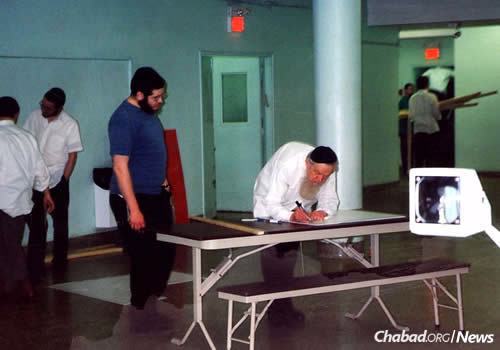
A master of many trades, Cohen is a family man, an educator, a sofer (“scribe”) who makes mezuzahs and tefillin for his community, and serves as the volunteer organizer for many of the city’s other Jewish functions, including the annual Sukkot street festival, public menorah-lightings at Chanukah time and burning of the community’s chametz before Passover. (Funding for such projects also comes from the Lubavitch Youth Organization.)
As with Minkowitz, Cohen’s first Lag BaOmer experience was also unforgettable.
A longtime Montreal resident, the rabbi attended yeshivah in Crown Heights. During his first year there, he remembers being amazed and delighted to see the frenzy that erupted among the students as they prepared for the parade. “The boys were busy painting signs, constructing floats . . . , ” he describes.

‘A Beautiful Accomplishment’
Comprising almost 100,000 Jews, Montreal’s Jewish community is the second-largest in Canada after Toronto and one of the largest in North America. Nevertheless, Cohen thinks back two decades, when local leaders struggled with organizing a parade.
He remembers declaring that “it’s impossible that this year we’re not going to have a parade. We have to do something!” So he went to the head of the local boys’ yeshivah and said, “Let’s just take the kids out of school, print some signs and walk around the block. When we finish walking, we’ll give out snacks, make a blessing and say some biblical verses together.” When the head of the yeshivah agreed, Cohen approached Minkowitz, who was more than happy to have the students join in the festivities.
With just a few hours to pull the event together, Cohen sprang into action: “I went to a 24-hour shop and printed signs.” In the spirit of the holiday, the signs read: “Be Happy, It’s Lag BaOmer,” “Love Your Fellow” and other slogans. When it was finally time for the parade, “we didn’t even have sticks to attach the posters to, so the kids held them with their hands.” But the children were elated, and the event proved a huge success.

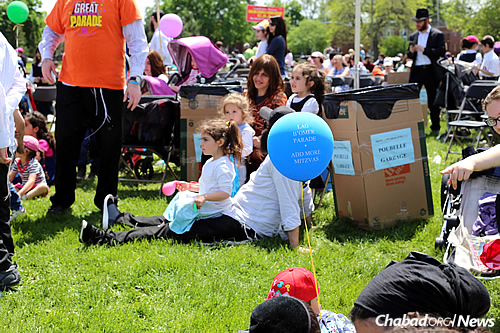
Cohen has been running the parade—now one of the largest in the world—ever since, with the help of his wife, Sarah, and their seven children (now grown). One year, he recalls falling asleep in the wee hours of the morning with the signs still unfinished. He woke at 7 a.m. to discover that his kids had taken up where he left off and finished the work.
Indeed, it has truly been an extended family undertaking. Cohen’s father-in-law, Rabbi Volf Greenglass—a Polish-born Kabbalist, and a highly regarded scholar and spiritual mentor—would get involved with the festivities as well. He made a practice of joining the yeshivah students as they worked through the night preparing for the parade.
The parade has continued to increase in number and exuberance. Often, Lag BaOmer occurs on a weekday, which means that students at the local Jewish schools are the main participants. But when it falls on a Sunday, as it does this year, throngs of people attend. In 2014, also a Sunday, more than 5,000 people turned out—an amount of people expected this year as well.

Jamie Hope Wajcman, a 20-year-old student at Dawson College in Montreal, plans to join this year’s parade, as she did two years ago. Studying in the community recreation leadership-training program, she is one of the few Jewish students currently in her class. Lag BaOmer represents a chance, she says, “to be with the Jewish community, celebrating and uniting as one.”
“It feels warm and comfortable to be a Jew,” surrounded by so many others—“to be around people who believe in the same things, who have the same identity.”
She will be accompanied by her Friendship Circle “buddy,” 6-year-old Reesa Slavin, taking her to the march and the festivities afterwards. Wajcman has been involved with the Chabad-affiliated organization, which pairs children with special needs and teenage volunteers, since seventh grade, enjoying the shared time and opportunity to see the progress made by the children.
Wajcman plans to stay as long as Reesa wants: “I’m really excited to go.”
The event starts at 12:30 p.m. at Côte Saint-Luc City Hall, where Mayor Mitchell Brownstein and local Chabad Rabbi David Banon will address the crowd before everyone parades to a soccer field at 5785 Avenue Parkhaven. Afternoon festivities include acrobats, clowns, bounce houses, music, kosher snacks, some words of Torah and a gift for every child.
“The Rebbe always said that there’s no better way to manifest unity and love for one another than when a group of people march together,” says Cohen. “Because when they do, though they may be coming from different walks of life, they are drawn together as one. And that unity is a beautiful accomplishment.”
Related Article:
Israel’s All Fired Up for Lag BaOmer Festivities

Parades, bonfires and special events, with a focus on children
Related Article:
Hot Soup to Emergency Workers Grappling With Floodwaters in Montreal

A Chabad family of seven pitches in where they can, as rain and snow continue to fall
Also This Week:
Chabad Garden Outside Chicago Protects an Endangered Species

A native plant butterfly garden graces the grounds in suburban Wilmette
Also This Week:
Bentzion Rader, 92, Visionary Lay Leader and Activist

His personal accounts of meetings with the Lubavitcher Rebbe inspired many


Start a Discussion