

The glowing Hebrew letters emerge out of pure white light. They each move independently, swarming across the screen like ants until an invisible force draws them together into a form. A human form basking in sunlight. The person, the earth and the sun all dissolve again into a phosphorescent nebula of sparks—pulsing, radiating and orbiting a single point of gravity. And as the animating glow slowly contracts into dull red embers, the camera pulls back to reveal the center of a sunflower blossom, the infinite expressed as finite.
This dense dreamlike vision is how the team at Torah Visuals—a new company that has created a series of animated videos to explain some of the fundamental concepts in Jewish mysticism—understands the paradox that everything is one, and people each feel and act as individuals. And it all unfolds in 30 seconds.
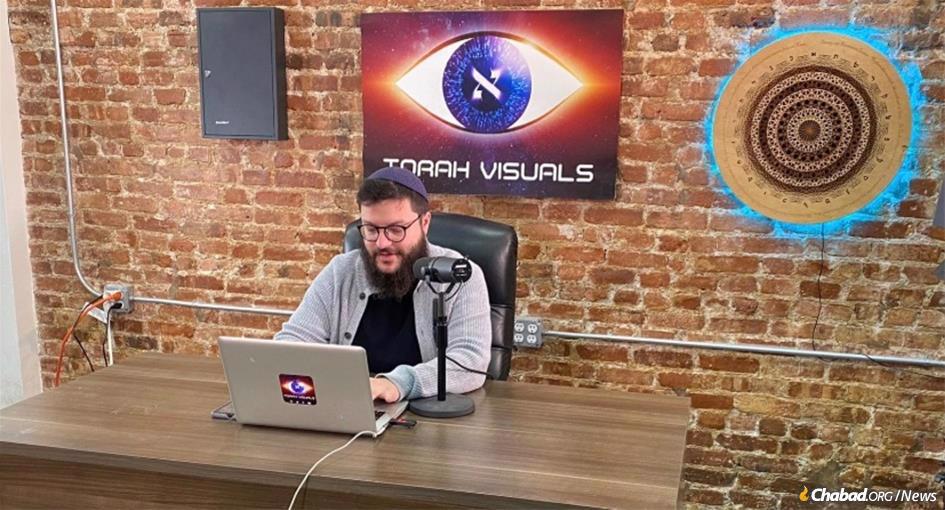
“Torah Visuals: We explain things you can never understand,” says Torah Visuals director and founder, Naftali Charter, with a chuckle. “Good luck to us.”


Charter is flame. He talks fast and thinks faster—bouncing between swashbuckling real-life stories of his years as a soldier and security consultant—protecting ships from pirates and orchestrating overseas jailbreaks—and grand visions for using his rabbinic training to unlock spirituality and redemption for millions.
As of two years ago, however, it wasn’t clear where Charter would be called to apply his high-intensity visionary personality to the world of Torah. And then, like so many people of his generation while at a crossroads in life, he fell down a YouTube rabbit hole. “I was amazed by the [potential for] scalability [of teaching Torah on YouTube],” he remembers. “A five-minute class could be watched by 1 million people across the world—multiplying the five minutes into 5 million minutes.”
But when he thought about recording classes for YouTube, he looked into the camera and realized that “no one wants to listen to me speak. … No one wants to listen to anyone speak for that matter … .” He concedes that when a person already has a connection with a particular speaker, he or she may enjoy watching a talk, but that kind of frontal speaking is unlikely to break into new communities, help forge new relationships or excite new demographics.
Then late one night, Charter was sitting with a friend who said: “Dude. Animation.”
“And it just clicked.”
Within weeks of that night, Charter connected to animator Shmueli Bell, who would become Torah Visual’s animation/art director, and they started a company.
Just like Charter, Bell grew up going to religious schools. But unlike the life of adventure that called to Charter, Bell was drawn from an early age to the quiet universe of animation—painstakingly crafting full computer animations with crude software when he was only 7. As he matured, he eventually found a yeshivah that would allow him to work on art alongside his Torah studies.
“If someone was charged with digitizing the Torah and they went to look for the 10 holiest [people] out there to do this, they’re not stumbling across us,” says Charter. “But that’s the beauty of it; we’re not renowned principals and educators and rabbis.”
Instead, each member of their 11-person team brings something unique to the enterprise, which both adds to the quality of the content and increases its broad accessibility.
Bell shares Charter’s obsession with accessibility. “Our intention with Torah Visuals from the beginning was … [to] make content that is appealing to people who … don’t even necessarily know what they’re seeking, but generally feel an inclination to spirituality.”
Unsure where to follow this numinous yearning, Bell says they often turn to the Internet, and more specifically, YouTube. “We really wanted to make something that would take the deepest teachings of Chassidus and Kabbalah and things that are only accessible if you’re willing to put a lot of time into listening to classes or reading books yourself and learning them, and to condense our knowledge of those things—to package it into a way that would be understandable and accessible to the whole world.”
The Creation: From Page to Image
Each video focuses on a different concept that appears in the Tanya, written by Rabbi Shneur Zalman of Liadi and published in 1797. So far, the episodes cover topics such as how the Infinite can be contained within the finite; how G‑d orchestrates reality despite being hidden from view; and how “speech” functions as a metaphor for how reality is made manifest.
Charter estimates that every three-minute video requires 400 hours of human effort to produce. Each episode begins with writer/narrator Alter Deitsch researching the material from many sources and discussing it with Chabad.org senior editor Tzvi Freeman.
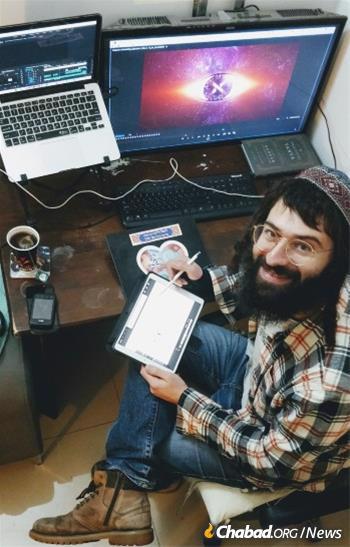
Next Bell enters the conversation. “I try to listen to them and to think on every line, ‘OK. How do we visualize this?’ ” Once the three of them decide on a visual metaphor, Bell draws “very, very loose thumbnails” for every shot on an iPad and inserts them into the script document.
Jewish law strictly forbids trying to depict G‑d in any way, which makes Torah Visuals’ task all the more challenging.
“It’s a very fine line that we’re toeing,” says Bell, “because on the one hand we would never, G‑d forbid, ever portray G‑d because no one ever can and that’s the whole essence of Judaism that G‑d cannot be portrayed, but at the same time, we can portray metaphors that can help you understand better what you don’t understand … .” Because of this fine distinction, more rabbis are called in to approve the team’s chosen visualizations at this stage in the process. “We don’t want to be told that something isn’t OK later in the animation (as we’ve already learned in our process). It means a lot of time and resources get wasted,” says Bell.
Then, Deitsch records a loose narration track and Bell makes an animatic—a basic black-and-white animated “skeleton” of the final animation, at which point the rest of the animators, Yisroel Fehler, Yitzchok Shmuckler and Chana Corna, get involved.
“Each of us is strong in different areas, so we’ll discuss which part each of us is going to animate, and arrange that, and then work, work, work, work, work, work … ,” says Bell.
“Imagine having an easel and four artists, and giving them all paintbrushes and saying to them: ‘Paint!’ It would never happen,” says Charter. “So it’s been really amazing to see all these artists gel into a team and work together.”
When the animation is finally complete, Aizik Chanin, Torah Visuals’ sound engineer composes music, rerecords Deitsch’s vocals, and the final edit is complete. Speaking of the process, Bell says, “The pieces often intertwine and go back and forth between each other—it never happens in that order 100 percent smoothly—but that’s the framework we developed in the time we’ve been working. It’s still evolving.”
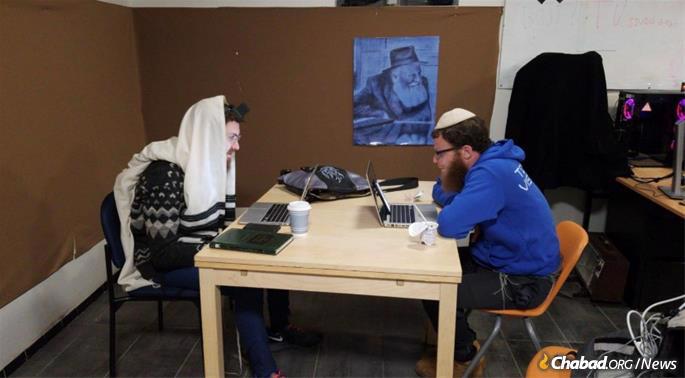
And all of this happens virtually. In fact, after more than a year of intense collaboration Charter and Bell have still never met face-to-face.
Bringing Holiness into the Digital Age
Charter and Bell hope all the hard work that goes into every episode is just the beginning for both the viewers and for Torah Visuals.
As for the viewers, Charter says, “It’s not just what this content teaches you. It’s what this content enables you to learn after. Once these foundational aspects are so clearly visualized inside your mind, you’re then able to open up a book … [and learn so much more and so much more deeply.]”
Bell adds, “If you know people whom you think would be inspired by this content share it with them. There’s a lot of people thirsting for this. So come get it!”
And as for Torah Visuals?
“There’s Torah Visuals, the product, and Torah Visuals, the company. The company is the team, and the ethics and goals that are shared among the team. The company is a group of individuals who see the opportunity and the timing of the need to transform the holiness and bring it into the digital age. We live in a time when people are spending 70 to 80 percent of their conscious moments in cyberspace, either on their phone or their computer.”
While they’re in the physical world, says Charter, time is consumed meeting their basic needs, but “when they’re online, that’s when their minds open to new things and new ideas.”
Charter believes that it’s essential to meet people where they are, even if that means following them into the far reaches of cyberspace. And so, he says Torah Visuals’ next project is to develop a “kosher virtual-reality experience.”
“History has seen stages in the way that Torah has been expressed. A new stage has broken through. We see a beautiful opportunity,” says Charter. “Virtual reality is a G‑dly-like tool. The ability to create a reality that someone can feel, see and hear things that are not real that is a G‑dly tool. … If G‑d has given us the ability to specifically do G‑dly like stuff—it’s a power that He’s never given mankind until now—it’s for a reason.” Charter thinks that reason might be to recode our reality from the bottom up with Torah and mitzvot alone, so as to infuse every possible experience with unprecedented holiness.
But even if the recoding of reality isn’t as imminent as many may hope, the project has already begun paying off. Bell says working so extensively on a concept has helped him to incorporate the ideas and values more deeply into his own life.
“The more you learn something, the more you start to see it,” he muses.
And as they say, seeing is believing.
See the first five episodes and subscribe to be notified when more are released at: https://www.torahvisuals.com/



I don't often make praising comments but this material is just delightful. Let me especially more that this project stands in stark contrast with some of the most extremist backward opinions in our religious community, who rail against internet and other things "virtual" as supposedly destructive and disruptive to Jewish soul and way of life and faith. These guys prove those reactionaries wrong